Artisanal vs industrial mining: safety and sourcing
Explore artisanal vs industrial mining, how safety shapes productivity, and what responsible gold sourcing means for investment decisions.
Key takeaways
- Artisanal and industrial mining describe operating scale and methods, not automatic measures of legality, safety or responsibility.
- Safety controls protect people and can reduce costly disruptions, but equipment alone cannot replace sound operating practices.
- Productivity depends on grade, recovery, costs and reliability—not simply how much material a mine moves.
- Responsible sourcing requires traceability and risk-based due diligence; it does not eliminate investment risk.
Two pieces of gold can look identical. But did the people who produced them work safely? Was the gold recovered efficiently? And can anyone explain its journey from mine to buyer?
For a young saver exploring gold, those questions may seem far removed from an investment decision. They are not. Mining conditions affect costs, continuity and the credibility of the supply chain.
At Teqwah, we see opportunity in connecting capital with productive work. Understanding artisanal vs industrial mining helps us explain why equipment alone is not the whole story—and why execution matters as much as the metal.
The important question is not simply whether a mine is small or large, but whether it turns resources into value safely, efficiently and responsibly.
1. Small or large: what are you really comparing?
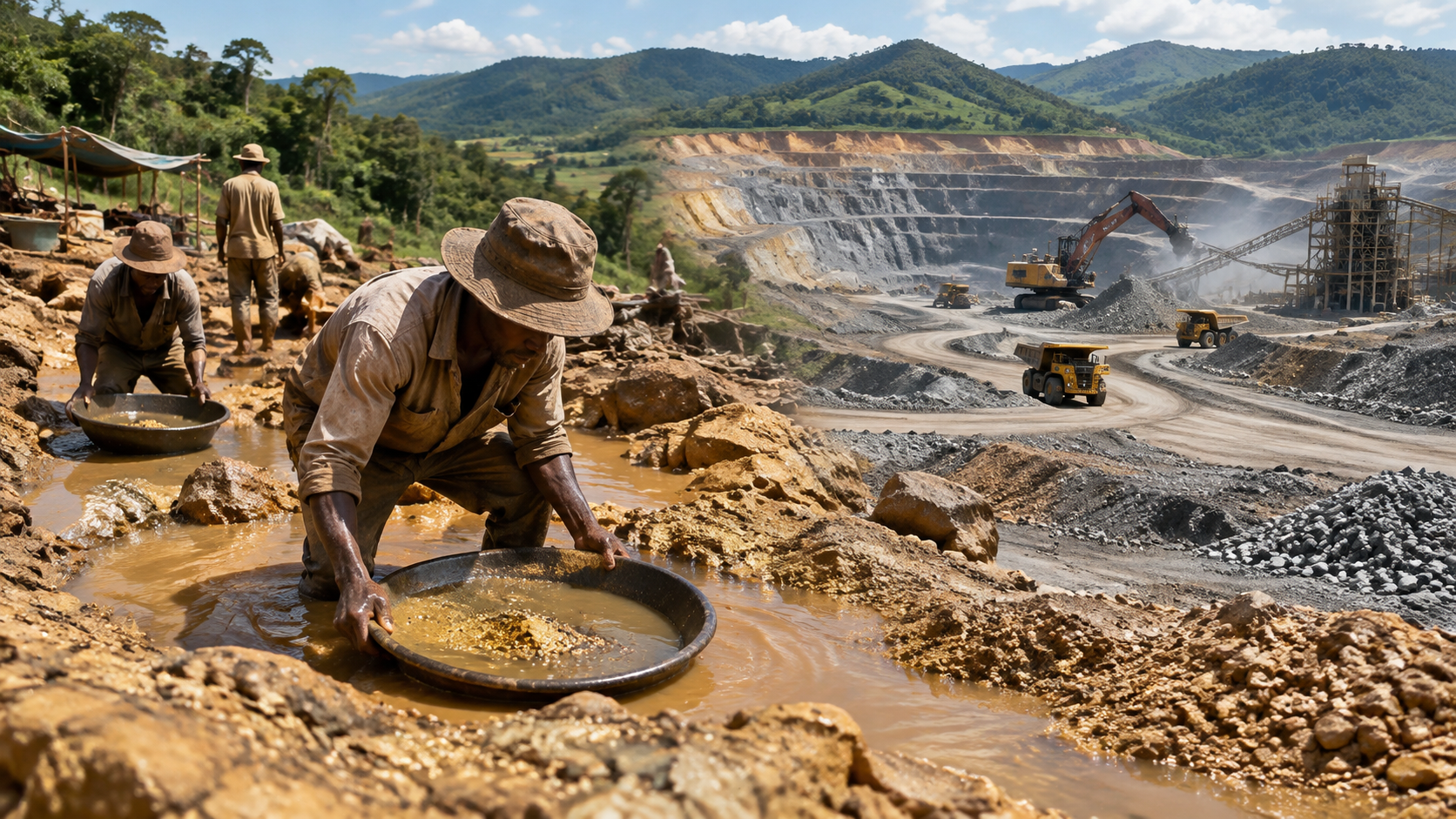
Artisanal and small-scale mining, often shortened to ASM, generally involves smaller operations with relatively limited capital and mechanisation. Some miners use hand tools. Others work in organised groups with pumps, crushers or other machinery.
Industrial mining usually involves larger investment, more mechanised extraction, engineered processing facilities and specialised teams. Think of the difference between a small workshop and a factory: both produce something useful, but their resources and operating systems differ.
These are broad categories, not quality ratings. Small-scale mining is not automatically illegal or irresponsible. Industrial mining is not automatically safe or well managed. Legal status depends on local requirements, and performance depends on actual practices.
For readers comparing opportunities, the better question is: what capabilities does this operation have, and what evidence supports its claims?
2. Safety: would better equipment solve the problem?
Imagine a small miner working below an unsupported excavation. A faster pump might remove water, but it cannot make unstable ground secure. Productivity improvements must address the real hazard rather than simply speed up the work.
Mining risks can include collapsing ground, dust, moving vehicles, dangerous machinery and chemical exposure. In some artisanal gold processing, mercury creates serious health and environmental hazards. It is not used by every small-scale miner.
Industrial operations may have more resources for ventilation, monitoring, training and emergency response. They can also introduce major hazards, including heavy-vehicle collisions and failures of tailings storage facilities, which hold processing waste.
When we explain mining economics, safety belongs inside the cost discussion—not outside it. Injuries, equipment damage and shutdowns can interrupt production and create lasting liabilities.
Useful questions include:
- Are ground conditions assessed and excavations properly supported?
- Are workers trained, with suitable protective equipment and emergency procedures?
- Are dust, chemicals, water and processing waste controlled?
- Are incidents investigated and corrective actions followed through?
A written policy is a starting point. What happens during an ordinary shift matters more.
3. Productivity: more earth moved, or more value recovered?
A shopkeeper would not judge success by how many boxes arrive at the door. What matters is what can be sold, at what margin, after expenses. Mining requires the same discipline.
Moving more material does not necessarily mean producing more gold. Output depends on ore grade—the amount of gold in the material—and recovery, the share successfully extracted. Fuel, labour, maintenance, water and power also shape the result.
A larger machine may increase throughput, meaning material processed over time. But if the processing plant cannot keep up, the operation has merely moved its bottleneck. If spare parts are unavailable, expensive equipment may sit idle.
Small operations can sometimes improve productivity through better ore sorting, maintenance and processing practices. Industrial operations can benefit from scale, but they also carry substantial construction, operating and closure obligations.
Why this matters: a credible investment explanation should connect production assumptions to costs and constraints. Gold in the ground is not the same as spendable profit.
4. Responsible sourcing: can you follow the gold?
Suppose a buyer receives gold from several small suppliers through one trader. An invoice records the sale, but does it establish where the gold originated or how it was produced?
Responsible sourcing means investigating and addressing supply-chain risks, not simply collecting paperwork. Relevant concerns include unlawful extraction, serious labour abuses, conflict financing, corruption and environmental harm.
Traceability means being able to follow material through the chain. Due diligence means checking the people, places and risks behind that chain, then responding to what is found. Neither process becomes unnecessary because the supplier is large.
Useful evidence may include mining permissions where required, supplier identity checks, production and purchase records, transport documents and credible assessments of working conditions. Documents need to be consistent with physical activity; paperwork alone is not proof of responsible practice.
Excluding every artisanal supplier is not automatically the most responsible answer. Where engagement is lawful and risks can be addressed, formalisation and better practices can help legitimate miners access markets. Serious abuses, however, cannot be excused by the value of the gold.
5. What does this mean for your participation?
For people who see potential in gold but cannot run a mine themselves, the attraction is understandable: capital and productive equipment can help turn resources into operating activity. The opportunity is exciting precisely because value must be created through execution.
At Teqwah Capital, we deploy equipment and operating capital into gold mining. Our activities also include physical gold trade, productive machinery and selected real estate. Our gold trade involves sourcing, consolidating, assessing and moving physical gold through documented channels. That description should not be mistaken for a claim of external responsible-sourcing certification.
Our TGC is a divisible participation unit recording a proportional share of our unified pool. Participants do not select individual mines or projects. Its recorded value is pool value divided by circulating TGC; it is not an exchange-traded market price.
Understanding mining helps you ask better questions about that participation. It does not remove operating risk or make future outcomes predictable.
Frequently asked questions
Is artisanal mining always less safe than industrial mining?
No. Smaller operations often face resource constraints, but size alone does not establish safety. Ground control, training, equipment condition and day-to-day supervision matter in both settings.
Does industrial mining always produce cheaper gold?
No. Scale can reduce some unit costs, but geology, energy, maintenance, financing and environmental obligations affect the result. Greater output does not automatically mean a better margin.
Does traceable gold mean a low-risk investment?
No. Traceability supports supply-chain scrutiny. It does not eliminate production problems, cost increases, gold-price movements or liquidity constraints. Responsible sourcing and investment risk are related but separate questions.
There is a compelling story behind productive gold operations—and it deserves careful reading. Explore how we connect participation with real operations at teqwah.com.
Investing involves risk, values can fall, and this article is education, not financial advice.
Teqwah view
At Teqwah, we connect participation with gold mining, physical gold trade and productive machinery, with selected real estate also within our pool. We believe understanding the work behind the gold helps you approach our TGC participation with clearer questions and realistic expectations. We invite you to explore that journey while recognising that recorded value can rise or fall.
Sources
Investing involves risk. TGC value can fall. This is not investment advice.
Comments
No comments yet — be the first.