
Deutsche Bank: gold is winning back central bank reserves from the dollar
The dollar's share of global reserves has fallen from over 60% to about 40%, while gold has climbed to nearly 30%, a new Deutsche Bank Research report says.
Key takeaways
- The dollar's share of central bank reserves fell from ~60% to ~40%; gold rose to nearly 30%.
- All central bank gold buying since 2008 came from emerging markets (225m+ oz).
- Emerging markets hold 16% of reserves in gold vs 34% for advanced economies.
- Deutsche Bank sees room for gold to reach at least a 40% reserve share.
- One scenario puts gold at $8,000/oz within five years. It is a scenario, not a promise.
In a report titled The return of history: gold, the dollar, and the monetary future (27 April 2026), strategists Mallika Sachdeva and Michael Hsueh at the Deutsche Bank Research Institute argue that the post-1989 world order is over, and that this is reshaping what central banks hold.
The big shift in plain numbers
- The US dollar's share of global central bank reserves has dropped from about 60% at its peak to around 40% today.
- Gold's share has tripled from its lows to nearly 30%, and doubled in just the past four years.
- The gap between the dollar and gold is now only about 10 percentage points. At the end of the 1990s, the dollar's share was more than four times gold's.
Why it is happening
The authors say gold's role in reserves follows geopolitics, not the monetary system. Gold's share did not fall when Bretton Woods ended in the 1970s. It fell after the Berlin Wall came down and the US became the single superpower. Today, they write, the world is back in a superpower struggle, the US is pulling back from free trade and alliances, and the dollar banking system "has been weaponized".
Rising prices explain about 80% of gold's larger share, but the report says real buying matters too: central bank purchases have themselves pushed prices up.
Emerging markets are doing the buying
- Every central bank gold purchase since the 2008 financial crisis has come from emerging markets, which added more than 225 million troy ounces over 17 years. That is more than advanced economies sold in the 1990s.
- At the end of 2025, emerging-market central banks held 367 million oz, against 712 million oz for advanced economies.
- Gold was only about 16% of emerging-market reserves, against 34% for advanced economies, which leaves a big gap to close.
- Buyers go well beyond China, Russia and India. Türkiye, Kazakhstan and Saudi Arabia are large holders. Qatar, Egypt and the UAE bought between 25% and 50% of their gold in the last few years alone.
How far could it go?
The authors say a "return of history" fits with gold reaching at least 40% of global reserves. In one of their scenarios, even if emerging-market foreign-currency reserves shrink to USD 5 trillion, gold could rise to $8,000 an ounce over five years, if those central banks all aim for a 40% gold share.
These are scenarios, not forecasts. Gold prices can fall as well as rise.
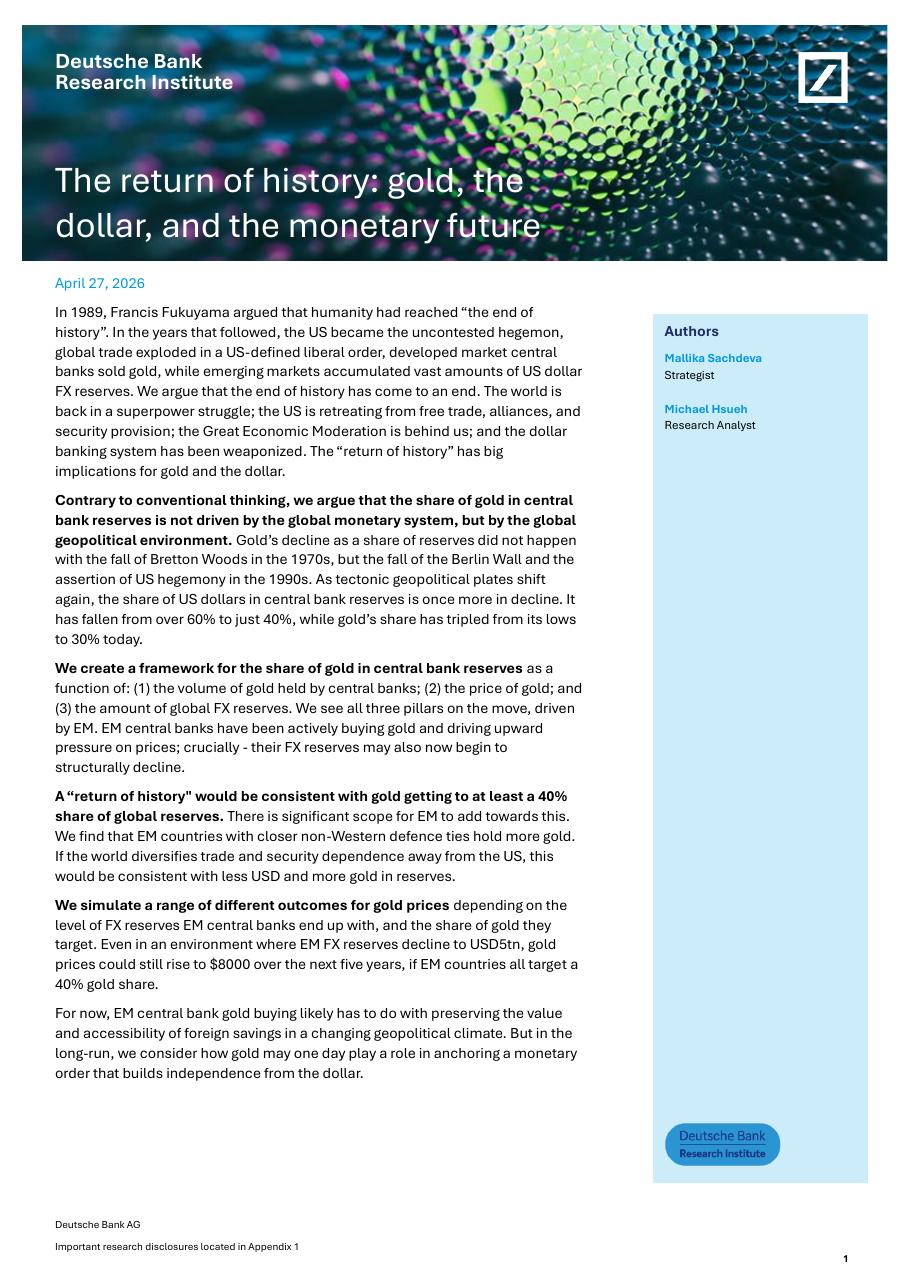
Cover image: front page of the report — Image: Deutsche Bank Research.
Sources
Comments
No comments yet — be the first.