
Purchasing Power: Why $100 No Longer Buys the Same Basket
If a $100 basket rises to $105, your unchanged balance buys less. We explain purchasing power, inflation and what to consider before investing.
Key takeaways
- A basket that rises 5% from $100 costs $105, so an unchanged $100 balance no longer covers it.
- A 5% price increase reduces purchasing power against that basket by approximately 4.76%.
- A growing balance can still lose purchasing power if it grows more slowly than the relevant prices.
- Consider everyday cash needs, investment risks, fees and access restrictions; investing does not automatically protect against inflation.
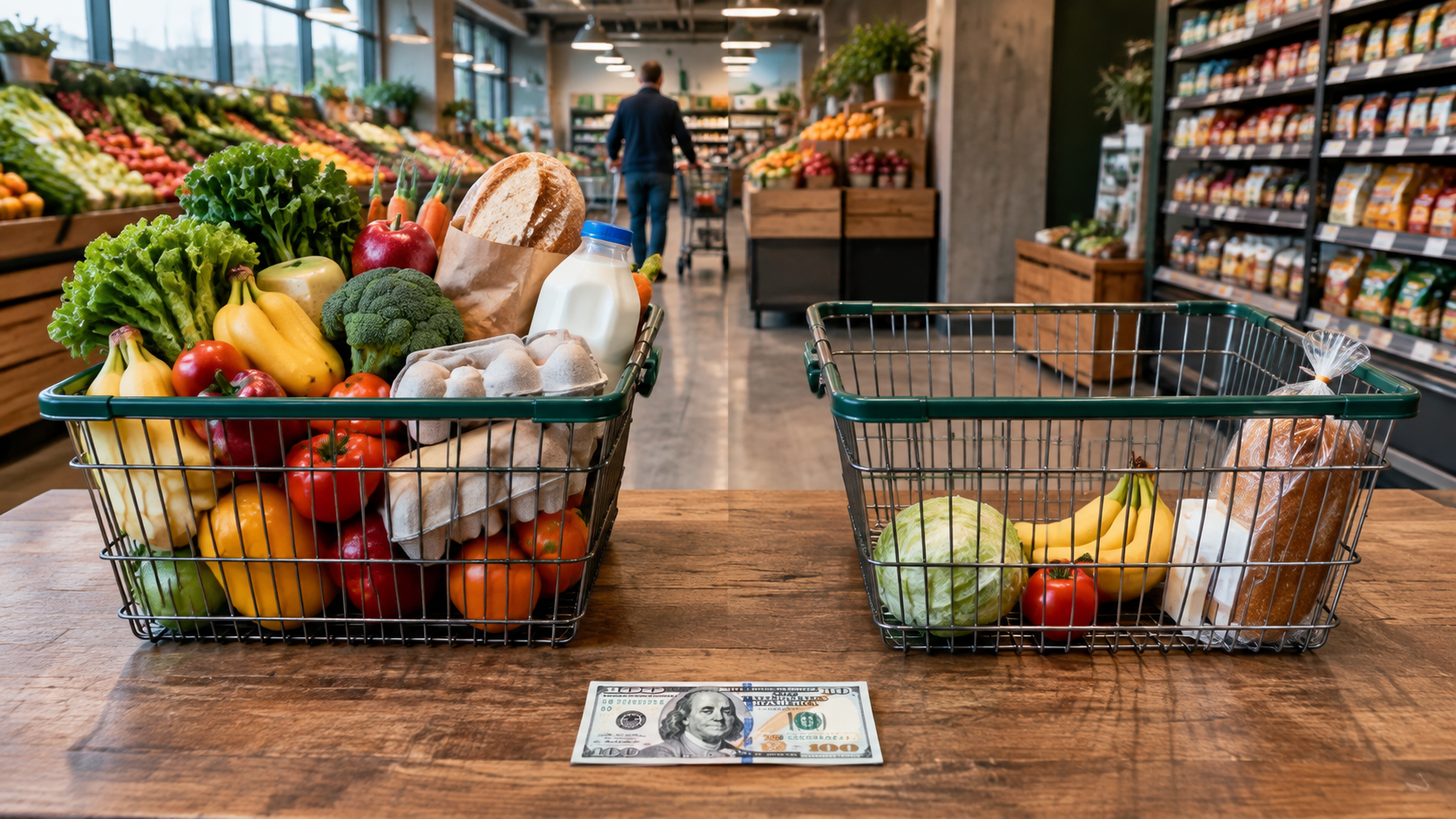
You walk into your usual shop with $100. Last time, that covered your whole basket. Today, the same groceries cost $105. Nothing has disappeared from your account. Yet something has changed: what your money can do.
At Teqwah, we believe this is one of the most useful starting points for understanding money. Before asking how much an investment might grow, it helps to ask what that money needs to buy.
The distinction is simple. Your balance counts dollars. Your purchasing power measures what those dollars can purchase.
Your bank balance can stay exactly the same while the amount it buys gets smaller.
The $100 basket: where did the missing buying power go?
Imagine a basket containing bread, rice, milk and household essentials. Its original total is $100. If the price of that same basket rises by 5%, the calculation is:
$100 × 1.05 = $105.
You now need another $5 to take home everything you bought before. With only $100, you must remove an item, choose a cheaper alternative or use additional money.
This is lost purchasing power in everyday life. It does not require a bank charge or a withdrawal. Prices have moved while your money has stood still.
There is a small but useful mathematical distinction. A 5% price rise does not mean purchasing power falls by exactly 5%. Your $100 now covers $100 ÷ $105, or about 95.24%, of the basket's new cost. Relative to that basket, purchasing power has fallen by about 4.76%.
The practical lesson matters more than the decimal: the old amount no longer covers the same purchase.
Is a higher grocery bill always inflation?
A shopkeeper might raise the price of one product because a delivery is delayed. You might spend more because you switched to a premium brand. Neither situation, by itself, establishes a general rise in prices.
Inflation means a broad increase in the prices of goods and services over time. Our basket illustrates the effect; it is not a claim about any country's current inflation rate.
For a fair comparison, keep the contents and quantities the same. If last month's basket contained more food, comparing only the totals can mislead you.
Your own experience can also differ from a published inflation measure. A young saver living with family may spend mostly on transport and food. A parent may face rent, childcare and school expenses. Their spending patterns are different, so price changes affect them differently.
Why this matters: the most useful starting point is understanding the costs your money actually needs to cover.
Why a bigger balance may still leave you standing still
Suppose your $100 becomes $103 over the same period in which the basket rises to $105. Your balance has grown by 3%, but you still cannot afford the full basket.
That introduces two useful terms:
- Nominal value: the money amount shown on your statement.
- Real value: what that amount can buy after allowing for price changes.
In this example, the change in buying power is calculated as 1.03 ÷ 1.05 − 1, or about −1.90%. The balance rose, but its purchasing power against this basket fell.
If the balance reached $105 instead, it would just keep pace with the basket, before any relevant fees or taxes. A larger number is not automatically a greater ability to spend.
We encourage readers to bring this question to any financial comparison: “Am I measuring more money, or more buying power?” It makes headlines about growth much easier to interpret.
What can you do without rushing into an investment?
Start with the purpose of the money. Cash for next month's rent has a different job from money set aside for a distant goal.
Keeping accessible cash can be sensible even when prices rise. The ability to pay an urgent bill matters. Investing that money introduces other risks, including the possibility that its value falls or that you cannot access it when needed.
A practical review can begin with three steps:
- Track a small basket of your regular expenses, keeping quantities consistent.
- Separate near-term spending needs from longer-term goals.
- Compare investment risks, fees and access restrictions alongside potential outcomes.
There is no need to treat every price increase as a signal to buy something. The aim is a clearer decision, not a faster one.
Why this matters: protecting your ability to meet everyday needs is part of managing purchasing power, too.
Where productive investment enters the conversation
For people who see potential in gold but cannot run a mine themselves, we offer a way to participate in productive operations. A Teqwah investment uses TGC, our divisible participation unit, to record a proportional share of our unified pool across gold mining, physical gold trade, productive machinery and selected real estate.
The connection to purchasing power is a question, not a promise: can productive activity create value over time? Equipment must work, operations must be managed and costs must be covered. That is the opportunity we are working to build at Teqwah—value through execution, rather than a fixed outcome.
TGC's recorded value is pool value divided by circulating TGC. It is not exchange-traded, and its value can fall. Participation does not establish that you will keep pace with inflation or preserve purchasing power.
Before participating, explore how our operations, fees and lock-ups work. Understanding both the opportunity and its limits is a stronger foundation than reacting to a higher grocery bill.
Frequently asked questions
What is purchasing power?
Purchasing power is the amount of goods and services your money can buy. If the same items cost more while your balance stays unchanged, your purchasing power falls.
Does a 5% price rise mean I lose 5% of my money?
No money necessarily leaves your account. In our example, $100 still remains $100, but the basket costs $105. Your purchasing power against that basket falls by approximately 4.76%.
Does investing automatically protect against inflation?
No. Investments can lose value, and fees or access restrictions also matter. Any outcome must be assessed against price changes over the same period.
Ready to see how we connect participation with real operations? Explore TGC at Teqwah →
Investing involves risk; values can fall. This article is financial education, not financial advice.
Teqwah view
At Teqwah, we connect participation through TGC with gold mining, physical gold trade, productive machinery and selected real estate. We are building an opportunity grounded in productive work, and we invite you to understand how recorded operating results affect value. That value can rise or fall; participation is not a promise of preserving purchasing power.
Sources
Investing involves risk. TGC value can fall. This is not investment advice.
Comments
No comments yet — be the first.