UAE–Syria central bank pact puts payments at heart of closer ties
A preliminary agreement covers banking expertise and financial technology as Syria rebuilds regional links and seeks investment.
Key takeaways
- The UAE and Syrian central banks signed a preliminary framework for closer technical co-operation.
- The agenda includes payments, monetary policy, cash management, financial technology and risk management.
- Both governors said the framework could strengthen banking services and expand opportunities for financial institutions.
- The agreement comes as Syria rebuilds regional ties and pursues housing and property investment.
- Separately, the UAE central bank renewed a Dh5 billion currency swap arrangement with Egypt for five years.
Syria plans to build or restore two million homes by 2035, and Gulf investors are looking at its property market. Alongside that push, its central bank is strengthening ties with the UAE. The two monetary authorities have signed a preliminary co-operation agreement covering the systems and expertise that support banking, according to The National — Business.
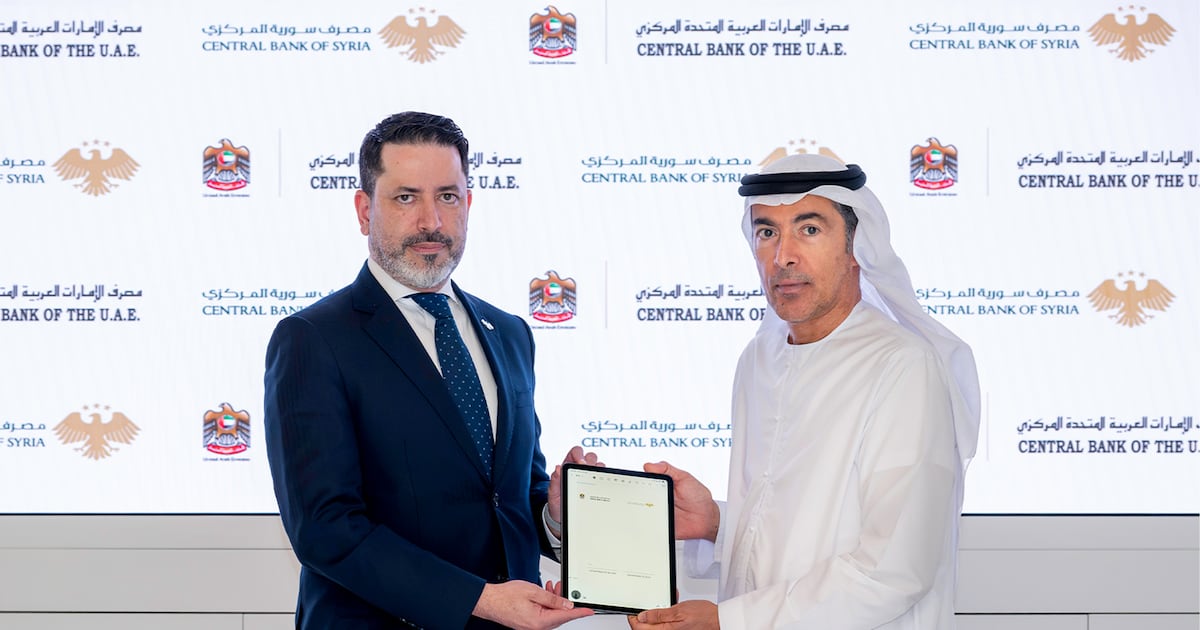
The Central Bank of the UAE announced the agreement in a statement on Friday. Signed by UAE central bank governor Khaled Balama and Syrian central bank governor Mohammad Raslan, it establishes a framework for sharing technical expertise. Its scope stretches from payment systems, which move money between users, to monetary policy, the management of money and credit, as well as cash management and financial technology.
Banking links beyond investment
The framework also reaches into how banks understand customers and manage risks. It covers financial inclusion, or access to financial services; financial literacy and awareness; and credit information systems, which hold information used to assess borrowers. Reporting and risk management are included too. The agenda also encompasses climate risk management and sustainable finance, which brings environmental and other long-term considerations into financial decisions.
Balama presented the agreement as a way to strengthen the financial system and make its infrastructure more efficient while keeping up with changes in financial technology. He also expressed hope that closer co-operation would give financial institutions in both countries more opportunities and help the sector contribute to economic growth. His statement framed the work around both the strength of the banking system and its wider economic role.
Balama said he hoped closer co-operation would broaden opportunities for financial institutions in both countries and strengthen finance’s contribution to growth.
Raslan, meanwhile, described the agreement as a starting point for practical, lasting work between the two central banks. He said it could improve banking services, support monetary and banking stability, and create more room for banking partnerships between Syria and the UAE. Both governors’ comments focused on what the framework could enable, rather than presenting those gains as already achieved.
Syria’s regional opening
The agreement comes as Syria rebuilds relationships with neighbouring countries following the fall of Bashar Al Assad’s government and the removal of Western sanctions last year. Gulf states and other regional countries are providing diplomatic, financial and infrastructure support. In property, UAE-based developer Arada and Emaar founder Mohamed Alabbar have disclosed investment plans, alongside Syria’s wider ambition to tackle housing shortages through its two-million-home programme.
The UAE central bank has also been reinforcing another regional relationship. Earlier in the week, it agreed to renew a Dh5 billion ($1.36 billion) currency swap arrangement with Egypt—a framework for exchanging currencies. That renewed agreement runs for five years and is intended to strengthen trade and financial co-operation between the two countries.
For Syria and the UAE, the next thing to watch is how the preliminary framework develops into the practical co-operation Raslan described: stronger technical expertise, more efficient banking services and wider banking partnerships. Those are the areas the governors identified as the agreement’s intended benefits.
Sources
Investing involves risk. TGC value can fall. This is not investment advice.
Comments
No comments yet — be the first.