Compound Inflation: How Small Price Rises Add Up
At 3% annual inflation, a $100 basket costs about $134 after ten years. Learn how compounding affects purchasing power and long-term planning.
Key takeaways
- At a hypothetical constant 3% annual inflation rate, a $100 basket would cost approximately $134.39 after ten years.
- Inflation compounds: each year's percentage increase applies to the already higher price.
- An unchanged cash balance can lose purchasing power; in this illustration, $100 loses approximately 25.6% of its starting purchasing power.
- Planning should consider inflation alongside investment risks, fees and access to money; no investment automatically preserves purchasing power.
You walk into your usual shop with the same budget. Nothing in your basket feels extravagant. Yet the total keeps edging higher, and the money left over keeps shrinking.
How can small price increases make such a noticeable difference?
At Teqwah, we believe understanding that question is a useful starting point for thinking about your financial future. Inflation does not need to be dramatic to matter. Give modest increases enough time, and compounding does the rest.
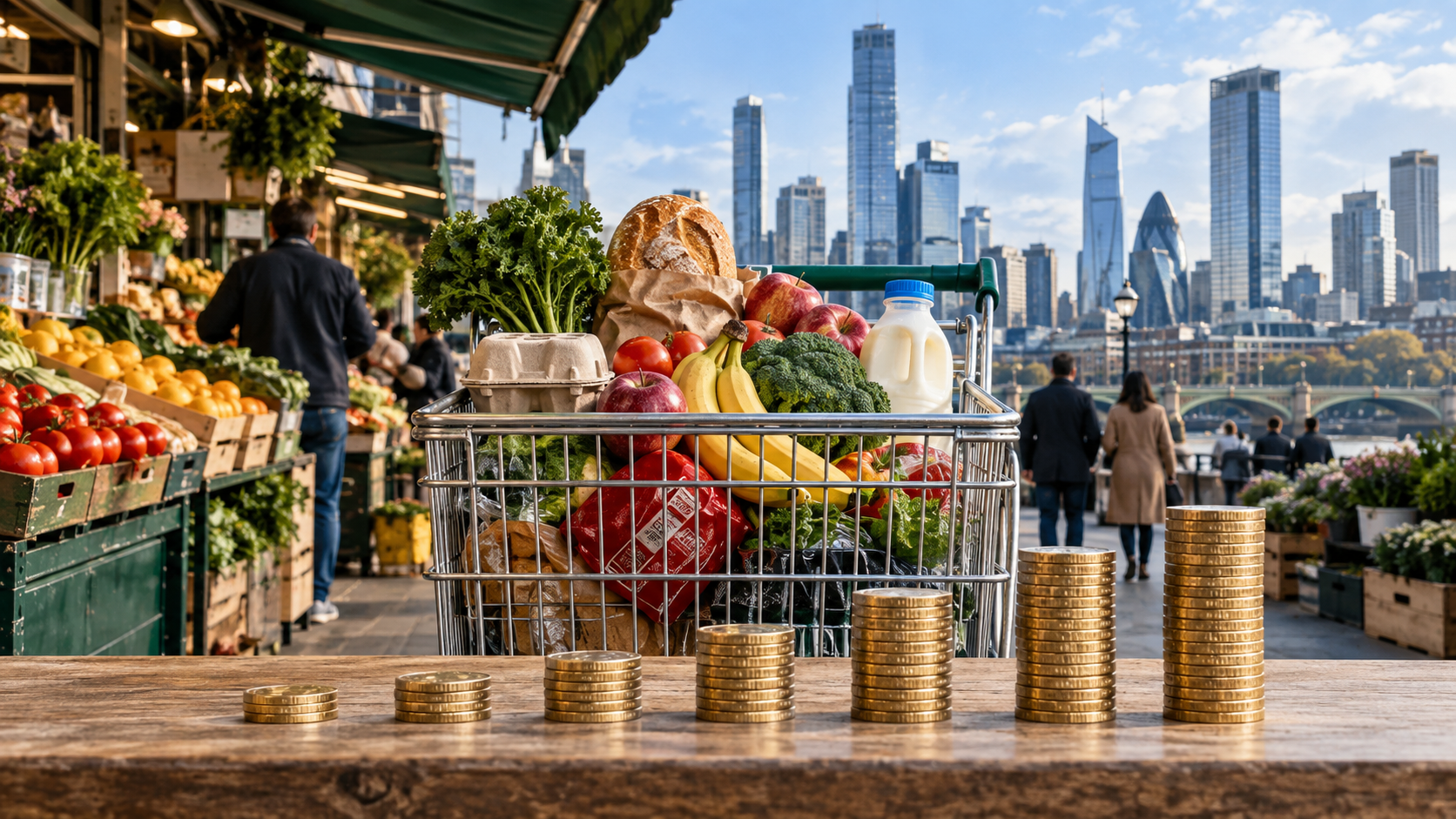
Here is the simple illustration: if prices rise 3% each year, a basket costing $100 today would cost about $134 after ten years. This is an illustration, not a forecast.
Why a small annual increase becomes a bigger bill
Imagine a shopkeeper selling the same basket of household essentials each year. For this example, its contents and quality stay unchanged, and its price rises by exactly 3% annually.
After the first year, the $100 basket costs $103. After the second, it costs $106.09. That second increase is $3.09, rather than $3, because it applies to the already higher price.
That is compounding: each percentage increase builds on the previous one.
The calculation is straightforward:
Future basket cost = starting cost × (1 + annual inflation rate)^years
For our example:
$100 × 1.03^10 = approximately $134.39
| Time elapsed | Illustrative basket cost | |---|---:| | Starting point | $100.00 | | 1 year | $103.00 | | 3 years | $109.27 | | 5 years | $115.93 | | 10 years | $134.39 |
All figures assume the same hypothetical 3% annual increase, rounded to the nearest cent. Simply multiplying 3% by ten gives 30%, but misses the increases building on earlier increases. The compounded total is about 34.4%.
Small inflation rates matter because each year's price rise starts from the higher price left by the year before.
What happens to the money you already have?
Now imagine a young saver keeping $100 unchanged for ten years, with no earnings or fees. The balance still says $100. But under our illustration, the basket now costs $134.39.
The number of dollars has not fallen. What those dollars can buy has.
This is the difference between nominal value, the amount of money shown, and purchasing power, the goods and services that money can buy.
At the end of the example, $100 buys about 74.4% of the original basket. Expressed in starting-year purchasing power, it is worth approximately $74.41. That represents a purchasing-power decline of about 25.6%, not 34.4%: the price increase and purchasing-power decrease use different starting points.
Why this matters: a financial goal can move further away even while your account balance stands still.
How to plan without pretending to know future inflation
Perhaps you are saving for training, replacing essential equipment or building a family reserve. A target based only on today's prices may not cover tomorrow's bill.
We find it more useful to treat inflation calculations as planning scenarios, not predictions. Actual inflation changes, individual prices move differently, and your household's spending mix may differ from a broad inflation measure.
A family spending heavily on rent faces a different budget from someone whose main costs are transport and food. Neither needs every price to rise equally to feel the pressure.
A practical approach is to:
- Define the goal: identify what you want to buy and roughly when.
- Test different assumptions: see how lower or higher annual price increases change the target.
- Review regularly: update the budget as actual costs and your circumstances change.
- Keep near-term needs separate: money needed soon has different requirements from money intended for long-term investment.
Cash still has an important role in emergencies and everyday payments. Recognising inflation does not mean every dollar should be invested.
Why investment growth must be measured against costs
If an investment balance rises, are you necessarily better off? Not in purchasing-power terms.
A nominal return measures the change in money value. A real return adjusts for inflation. The exact relationship, using returns over the same period, is:
Real return = (1 + nominal return) ÷ (1 + inflation rate) − 1
For example, a hypothetical 3% annual investment gain alongside 3% inflation leaves purchasing power unchanged before fees and taxes. This is arithmetic, not an expected return from any investment.
Fees, applicable taxes and investment losses can further affect the outcome. Access matters too: money committed for a period may not be available when a bill arrives.
The useful question is therefore not just, “Could my money grow?” It is, “What risks, costs and access restrictions would I accept for that possibility?”
Where productive investment fits into our approach
At Teqwah, we are building participation around productive operations: gold mining, physical gold trade, productive machinery and selected real estate. Through TGC, our divisible participation unit, participants hold a proportional share of our unified pool rather than choosing individual projects.
For people who see potential in gold but cannot run a mine themselves, that offers a way to participate while we manage the operations. The opportunity is exciting precisely because value must be created through execution—not assumed from rising prices.
A machine needs productive work. Mining depends on operating outcomes. Physical gold trade involves costs and changing spreads. Inflation alone does not establish that any of these activities will produce a positive result.
Our Teqwah investment approach is not a promise to beat inflation. TGC's recorded value can rise or fall, and it is not exchange-traded. We invite you to understand how it works, including fees and lock-ups, before considering participation.
Frequently asked questions
Does 3% inflation mean prices rise 30% over ten years?
Not when compounded annually. Ten consecutive 3% increases produce a total increase of approximately 34.4%, because each increase applies to a higher starting price.
Will a $100 basket actually cost $134 in ten years?
We use that figure only to illustrate a constant 3% annual increase. Actual inflation and the prices of individual items will vary. It is not a forecast.
Does investing automatically protect purchasing power?
No. Investments can lose value or grow more slowly than prices. We encourage comparing potential outcomes with inflation, fees, risks and your need to access the money.
Understanding compounding is a small step with lasting value. Explore our approach at teqwah.com when you are ready to learn more.
Investing involves risk, values can fall, and this article is education, not financial advice.
Teqwah view
At Teqwah, we connect participation through TGC with gold mining, physical gold trade and productive operations. We see inflation education as a starting point for understanding why value must be created through real execution, not assumed. We welcome you to explore our approach with clear eyes: recorded value can fall, and returns are variable.
Sources
Investing involves risk. TGC value can fall. This is not investment advice.
Comments
No comments yet — be the first.