How to Read a Gold Assay Certificate: Fire Assay vs XRF
Learn what gold purity numbers mean, how fire assay compares with XRF testing, and which certificate red flags buyers should check.
Key takeaways
- Match the report to the actual bar, lot or sample before relying on its purity figure.
- Fire assay consumes a sample; XRF usually preserves the item but primarily measures near the surface.
- Fineness 999.9 means 99.99% gold by mass, while nominal 18-karat gold is 75%.
- An assay alone does not prove ownership, provenance, whole-bar authenticity or investment value.
A shopkeeper places a gold bar on the counter. Its certificate says “999.9”. The price looks attractive. But does that number describe the whole bar—or just the sample someone tested?
That question can change a buying decision. At Teqwah, we believe understanding the evidence behind gold makes its opportunities more accessible. You do not need to be a metallurgist. You need to know what was tested, how it was tested, and whether the report belongs to the gold in front of you.
A gold assay certificate is evidence about a tested sample—not automatic proof of everything a seller claims.
1. Start with the sample, not the shiny certificate
An assay measures the gold content of a sample. A gold assay certificate records the result, usually alongside identifiers, testing details and the issuing laboratory.
First, distinguish a laboratory report from a branded assay card packaged with a bar. Both can provide useful information, but they may offer different levels of detail about sampling and testing.
Before studying the purity figure, check:
- Issuer: Is the laboratory or refiner clearly identified and independently contactable?
- Identity: Do the report number, sample description and any bar or lot numbers match the transaction?
- Method: Does it name the test and, where relevant, a method reference?
- Result: Are gold content and units clear, with uncertainty or reporting limitations where applicable?
- Traceability: Who collected the sample, when was it tested, and how was it linked to the goods?
A sample number is not necessarily a bar serial number. Ask how one connects to the other.
Why this matters: A genuine report can still accompany the wrong gold.
2. Fire assay vs XRF: what did the test actually measure?
Imagine a small miner selling a batch of doré—partly refined metal containing gold, silver and other materials. Now imagine a jeweller checking an intact bracelet. These situations call for different testing decisions.
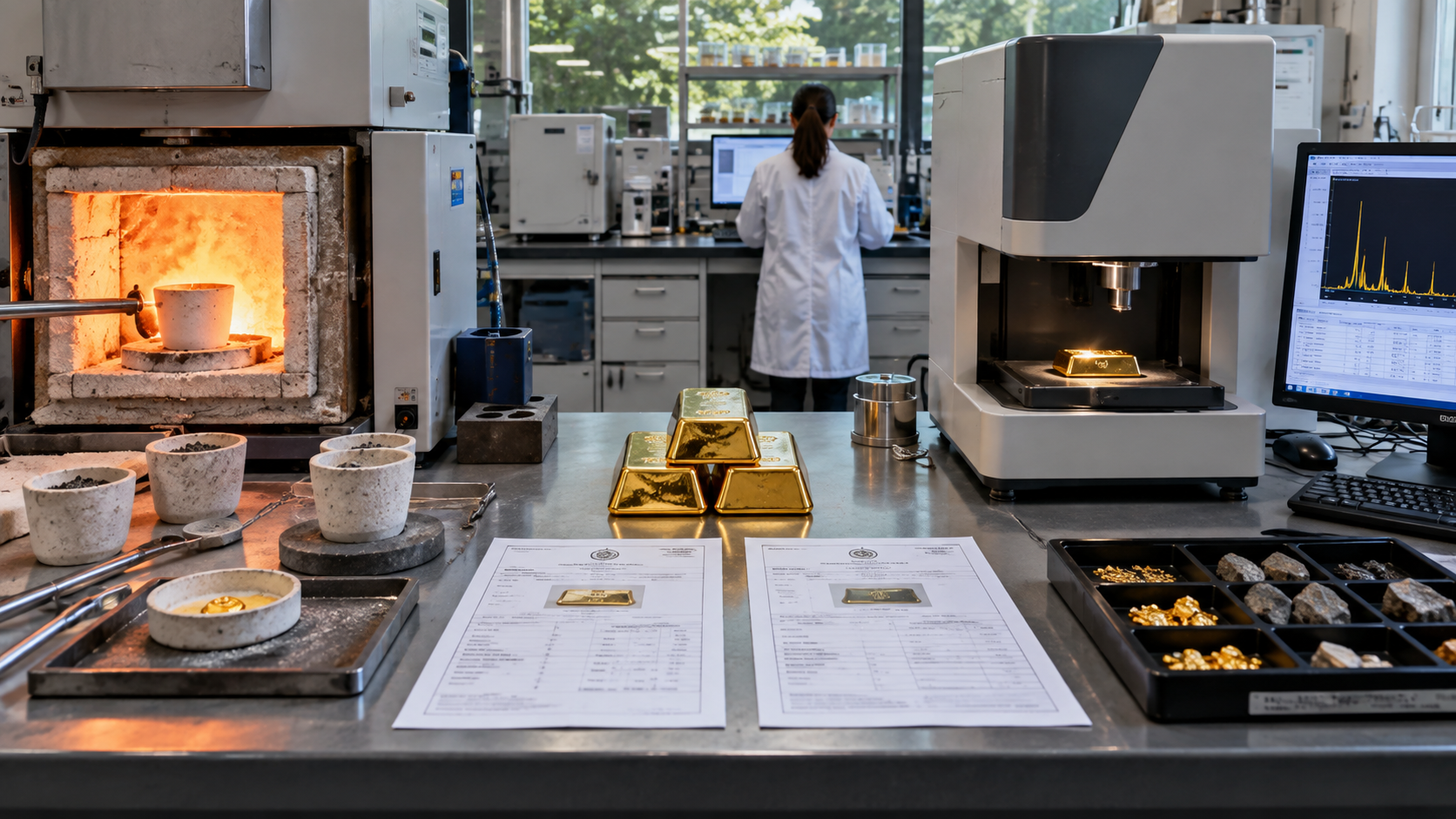
Fire assay uses high temperatures and chemical separation to isolate precious metals from a weighed sample. A finishing step determines its gold content. It is a well-established reference approach when the method suits the material and expected purity.
The trade-off is that fire assay consumes the tested portion. It also takes more preparation than a quick instrument reading. Most importantly, an accurate result still depends on a representative sample. A shaving from one corner cannot automatically speak for a mixed batch.
XRF testing, short for X-ray fluorescence, uses X-rays to identify elements and estimate their concentrations. It is fast and usually leaves the item intact, making it useful for screening and alloy checks.
Its limitation is measurement depth. XRF primarily examines a near-surface region, with depth depending on the material and instrument. Plating, surface enrichment, contamination, shape and calibration can affect the result. A high-purity surface does not prove a high-purity core.
Neither method wins every situation. For a substantial purchase, ask an independent qualified laboratory which sampling plan and complementary tests fit the item. Multiple surface readings can help, but they do not turn XRF into a full interior examination.
3. Decode 999.9, percentages and karats
Gold purity commonly appears in three formats:
- Fineness: Parts of gold per thousand. A result of 999.9 means 99.99% gold by mass.
- Percentage: A result of 99.5% equals fineness 995.
- Karat: A 24-part scale. Nominal 18-karat gold contains 18 parts gold out of 24, or 75%, equivalent to fineness 750.
The remaining material is not necessarily suspicious. Jewellery often contains intentional alloying metals that change hardness and colour.
Check the context, too. An ore assay might report gold in grams per tonne, not bullion fineness. Those are different measurements serving different decisions.
To estimate contained gold, multiply metal weight by the gold fraction. A hypothetical 100-gram metal sample assayed at 995 contains 99.5 grams of gold, assuming the result represents that sample. Exclude packaging and non-metal components from the calculation.
That is not a resale quotation. Refining deductions, testing charges, dealer margins and market conditions may affect payment.
More decimal places do not automatically mean better evidence. Ask whether a number is a measured result, a minimum specification or a rounded figure. Near a purchasing threshold, measurement uncertainty—the reasonable range around a result—can matter.
4. Spot red flags before money changes hands
A young saver may see a familiar logo and stop checking. We encourage the opposite: use the document as the beginning of verification.
Watch for mismatched serial numbers, altered text, missing units, an unnamed method, or a seller who refuses independent verification. A certificate claiming purity throughout a bar from a surface-only test deserves particular scrutiny.
A QR code is not proof by itself. It may lead to an imitation website. Find the issuer's contact details independently and ask whether the report exists and matches the stated sample. If accreditation is claimed, check that its scope covers the relevant testing; a logo alone is insufficient.
Also separate purity from provenance. An assay does not by itself establish legal ownership, responsible sourcing, customs compliance or investment value.
Why this matters: Good chemistry cannot repair a broken chain of custody—the record of who handled and transferred the sample.
5. Turn the certificate into a better decision
Before paying, agree on the applicable purity requirement, who samples the metal, who tests it, and what happens if results disagree. For larger transactions, independent sampling and a written dispute-testing procedure can reduce uncertainty.
At Teqwah, our gold trade activity includes physical gold being sourced, consolidated, assessed and moved through documented channels. That makes this distinction worth understanding: a purity result is one piece of a wider operating picture, not a promise of profit.
For people who see potential in gold but cannot run a mine themselves, our TGC participation connects to a unified pool across gold mining, physical gold trade, productive machinery and selected real estate. It is not ownership of the particular bar shown on an assay report. The opportunity we are building depends on execution and recorded operating results.
Frequently asked questions
Is fire assay always more reliable than XRF?
Not automatically. Fire assay can provide strong quantitative evidence from a suitable, representative sample. XRF is useful for rapid screening. Reliability depends on sampling, method suitability, calibration and competent testing.
Does 999.9 mean completely pure gold?
No. It means 999.9 parts gold per thousand, or 99.99% by mass. Check whether the figure is an assay result or a product specification.
Can a genuine certificate accompany fake gold?
Yes. A genuine report can be copied or paired with a different item. Verify both the document and its connection to the goods; use independent testing when appropriate.
Keep asking what sits behind the number. Explore Teqwah →
Investing involves risk, values can fall, and this article is education, not financial advice.
Teqwah view
At Teqwah, gold mining and physical gold trade are core activities, so we see value in helping readers understand what a purity result can—and cannot—tell them. We connect participants to our unified operating pool through TGC, with value shaped by recorded results rather than a promise of returns.
Sources
Investing involves risk. TGC value can fall. This is not investment advice.
Comments
No comments yet — be the first.