What Is a Sluice Box? Gold Recovery Explained
Learn how a sluice box separates gold, why water flow and cleaning matter, and why equipment capacity is not a promise of mining profit.
Key takeaways
- A sluice box uses flowing water and gravity to concentrate dense particles, including gold.
- Feed preparation, water flow, slope, even feeding and regular cleaning affect recovery.
- Equipment capacity does not establish daily gold yield or profit; feed grade, recovery, operating time and costs matter.
- TGC connects participants to our unified pool, not a chosen sluice or project; its recorded value can rise or fall.
Imagine watching a small miner shovel gravel into a channel of running water. Most of the material washes away. Something heavier stays behind. Could that simple process really help recover gold?
Yes—but the channel is only part of the story. At Teqwah, we believe understanding the work behind gold helps you ask better questions about the opportunity. A sluice box offers a useful starting point: an easy-to-picture tool whose results depend on careful execution.
What is a sluice box—and what does it catch?
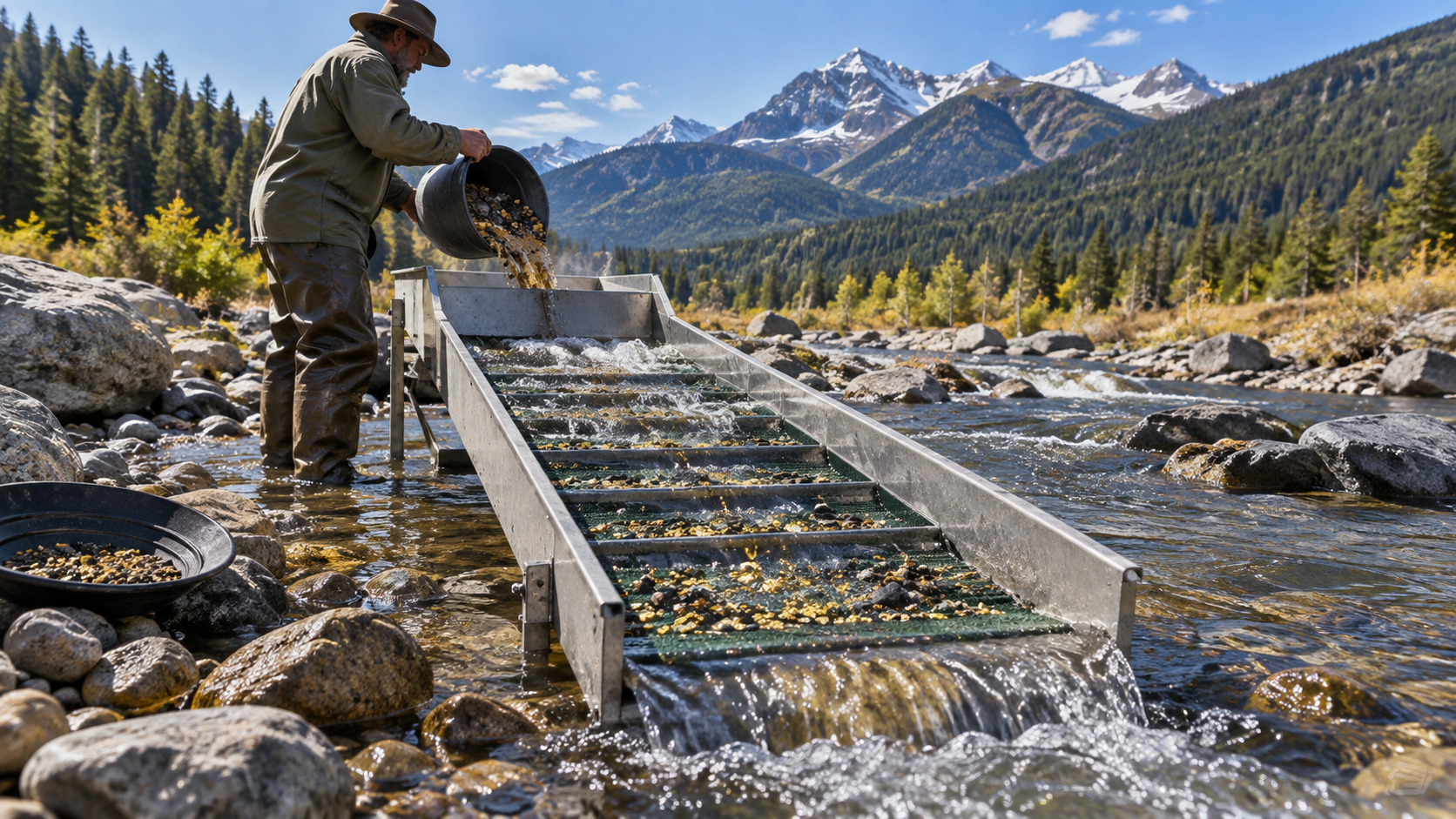
A sluice box is a channel that guides water and sediment over surfaces designed to retain dense particles. In gold recovery, it uses gravity and moving water to help separate gold from lighter material.
Many designs contain riffles—raised strips that create sheltered spaces—and textured matting. As sediment travels through the channel, these features help dense particles settle and remain while lighter material moves onward.
Think of leaves and pebbles in a shallow stream. Moving water carries them differently. A sluice uses that difference in a controlled setting, although particle size and shape also influence what happens.
It does not catch only gold. Other heavy minerals can collect too. The retained material is called concentrate: a smaller volume that needs further separation and assessment.
Why this matters: concentrate is not the same as saleable gold.
A sluice box separates material; its results depend on the feed, the water and the way it is operated—not on a promised daily gold yield.
How does a sluice box work in practice?
Picture a small miner preparing a batch of gravel. Before feeding the sluice, they may screen out oversized stones and break up clay that could hold gold particles. This preparation helps material move more consistently through the recovery area.
Water carries the prepared sediment along the channel. The setup must let unwanted material travel through while giving recoverable gold a chance to settle into the trapping surfaces.
The operator then stops periodically to remove the accumulated concentrate. That cleaning step is part of recovery, not merely housekeeping. Collected material needs careful handling so that particles retained earlier are not lost later.
A basic working sequence is:
- Prepare the feed and remove unsuitable oversized material.
- Establish a suitable slope and steady water supply.
- Feed material evenly rather than dumping large loads.
- Monitor the trapping surfaces and clean them regularly.
- Process the concentrate and check material leaving the system for losses.
A sluice is especially associated with alluvial material—sediment deposited by water. It does not, by itself, release gold locked inside solid rock.
Why can the same box produce different results?
Suppose two miners use similar equipment. One feeds screened gravel steadily. The other dumps mixed stones and sticky clay into uneven water flow. The boxes may look alike, but their operating conditions are very different.
Feed size and condition. Oversized stones can disrupt movement. Clay can keep particles bound together. Preparation matters because gold must be available for separation before the sluice can retain it.
Water flow. Too little flow can allow material to build up. Excessive or poorly distributed flow can carry recoverable particles away. There is no single setting that suits every feed and design.
Slope and installation. The channel’s angle affects how material travels. An uneven installation can send too much water down one side, leaving part of the recovery surface working poorly.
Feeding and cleaning. Overfeeding can overwhelm the trapping area. Accumulated material can reduce its effectiveness. Cleaning intervals need to reflect actual conditions rather than a universal schedule.
Gold characteristics. Fine, flat particles can behave differently from larger, compact pieces. No sluice should be assumed to capture every particle.
The practical lesson is straightforward: buying equipment is one decision; operating it well is another.
How do you turn recovery into a financial question?
For a young saver, “How much gold can this box produce each day?” sounds reasonable. But the box does not determine how much gold the ground contains.
A more useful relationship is:
Recovered gold = material processed × gold content × recovery rate.
Gold content means how much gold is present in a given amount of feed. Recovery rate is the share of that gold successfully captured. These measures must use consistent units, and each can vary.
Processing more gravel does not automatically mean recovering more gold. Low-grade material contains less gold, while rushed processing may increase losses. Downtime also reduces the material processed over a working day.
Then comes the business question. Like a shopkeeper subtracting stock and operating costs from sales, a mining operation must account for expenses before judging profit. Fuel, labour, maintenance and further processing can all affect the result.
Before accepting a production claim, ask what supports the feed grade, recovery estimate, operating hours and cost assumptions. Equipment capacity alone is not evidence of earnings.
Where this fits in our approach to gold
At Teqwah Capital, we deploy equipment and operating capital into gold mining, alongside physical gold trade and productive machinery activities. That is the opportunity we are working to build: participation connected to real work, where value must be created through execution.
For people who see potential in gold but cannot run a mine themselves, our TGC participation connects them to our unified pool rather than a self-selected machine or project. Participants do not choose individual assets; we manage allocation across our operations.
This explanation is not a claim that a particular sluice design is used in our operations. It is a way to understand the distinction between a useful tool and an investment outcome. A Teqwah investment follows recorded operating performance, and TGC is not exchange-traded. Its recorded value can rise or fall.
Frequently asked questions
Does a sluice box catch only gold?
No. It can retain other dense minerals alongside gold. The concentrate needs further separation before its gold content can be established.
How often should a sluice box be cleaned?
There is no universal interval. Feed composition, operating rate and the design affect how quickly trapping surfaces fill. Operators should monitor conditions and recovery losses.
Can a sluice box deliver a fixed daily gold yield?
No. Yield depends on gold content, material processed, recovery efficiency and operating time. Even recovered gold does not establish profit without accounting for costs.
Understanding the equipment makes the bigger opportunity easier to evaluate. We invite you to explore how our participation model connects capital with productive operations: Explore Teqwah and TGC →
Investing involves risk; values can fall. This article is education, not financial advice.
Teqwah view
At Teqwah, we connect investment capital with gold mining, physical gold trade and productive machinery operations. We see the opportunity in putting capital and equipment to productive work, while helping you understand why execution matters. Through TGC, you participate in our unified pool, with outcomes tied to recorded performance rather than fixed returns.
Sources
Investing involves risk. TGC value can fall. This is not investment advice.
Comments
No comments yet — be the first.