
Recovered Gold: Why It Is Not Yet a Retail Bar
Follow recovered gold from mine output to a retail bar, and learn why processing, purity testing, refining and records matter to its value.
Key takeaways
- Recovered material may contain silver, other metals or mineral residues; total weight is not the same as fine-gold content.
- Melting creates liquid metal for handling or casting, while refining removes unwanted constituents to reach a target purity.
- Representative sampling, suitable testing and supporting records help buyers assess a batch’s composition and identity.
- Processing costs, recovery, timing and sale terms separate the value of contained gold from actual operating profit.
Imagine a shopkeeper offering you two gold-coloured bars of the same weight. One has a stated purity and supporting records. The other has just arrived from a mining site. Would you pay the same amount for both?
Probably not. The difference is not simply packaging. It is what has been established about the material inside.
At Teqwah, we see that distinction as an important starting point for understanding gold operations. Recovering gold is an achievement. Turning it into a product a buyer can assess and accept takes further work.
Recovered gold is the beginning of a product journey—not proof of a finished bar’s purity or value.
What actually leaves a gold mine?
Picture a small miner weighing a newly recovered batch. The scale gives one useful number: total weight. It does not reveal how much of that weight is gold.
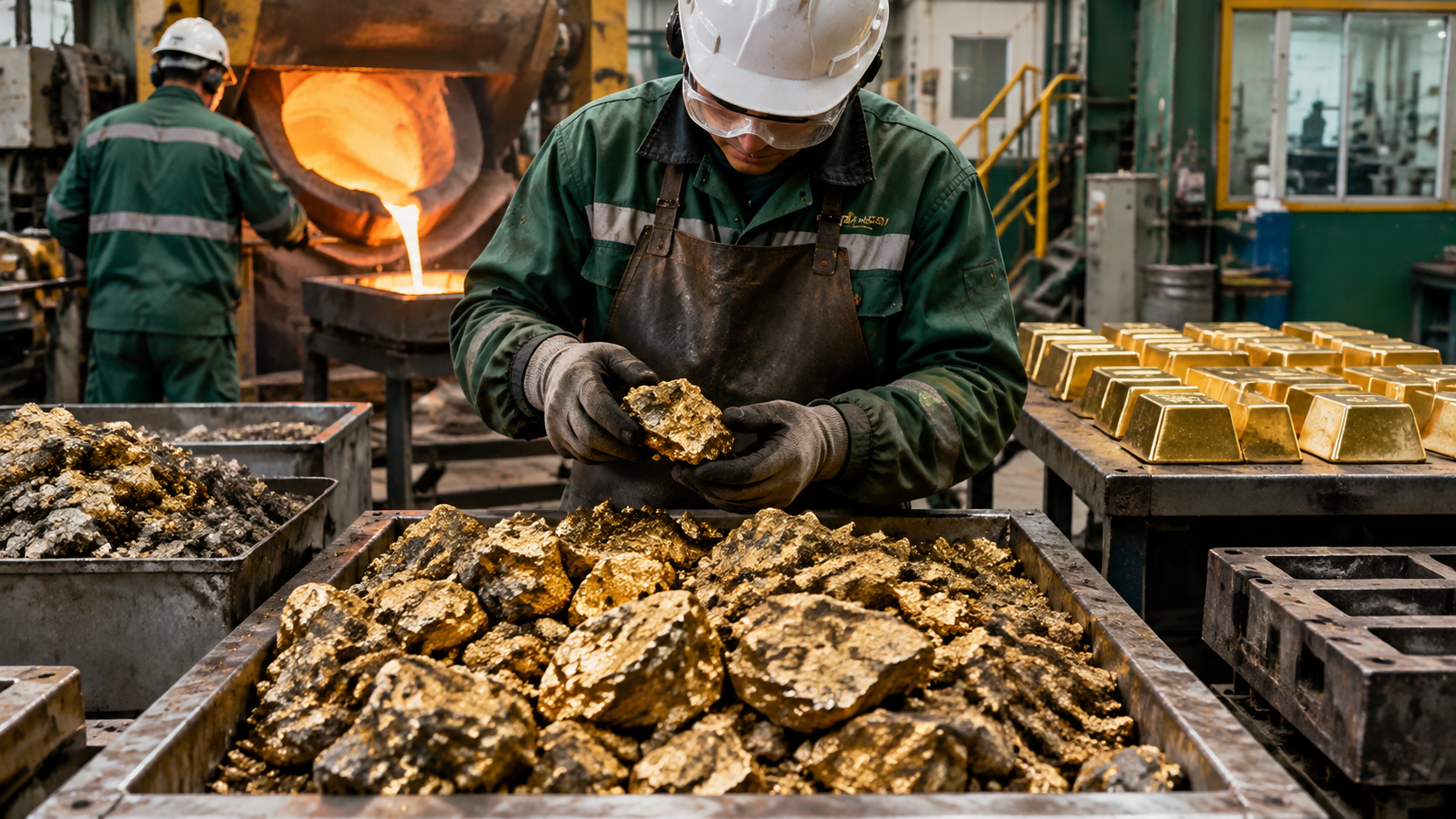
Depending on the deposit and recovery method, mine output may include mineral material, silver, other metals or processing residues. It might leave as a concentrate—a material enriched in gold—or as doré, a partly refined metal alloy commonly containing gold and silver.
Doré may already look like a bar. That shape does not make it a finished retail product.
This is the first distinction we encourage readers to make: the weight of gold-bearing material is not necessarily the weight of pure gold inside it.
Why this matters: a production figure tells only part of the story unless you understand what was weighed and how its gold content was measured.
Why melting is not the same as refining
A young saver might reasonably ask: “If the material has already been melted into a bar, what is left to do?”
Melting turns solid material into liquid so it can be handled, mixed or cast into a shape. Melting alone does not necessarily separate gold from the other metals mixed with it.
Smelting is different: it uses heat and chemical reactions to help separate metal from other material. Refining then removes unwanted constituents to reach a target purity. The exact route depends on the starting material and the intended product.
Think of melting a mixed-metal object. Its appearance changes, but changing its shape does not automatically make one metal disappear.
A batch may need further treatment before it meets a buyer’s specification. Some processing can happen at the mine; other work may happen elsewhere. There is no single sequence that applies to every operation.
Why this matters: a bar-shaped object is evidence of casting, not by itself evidence of investment-grade purity.
How testing turns an estimate into usable information
Before a buyer can value a batch with confidence, they need a reliable measure of its gold content. That is where an assay, or a test of composition, comes in.
Good testing starts with representative sampling. If the sample does not reflect the batch, even a carefully performed test may give a misleading picture of the whole lot. Different testing methods also have different capabilities; a surface reading may not establish the composition throughout a bar.
Purity is often stated as fineness: the number of parts of gold per thousand parts of material. A fineness of 999.9 means 999.9 parts per thousand are gold.
Here is a simplified example. If a 100-gram batch has a representative assay showing 80% gold, its calculated fine-gold content is 80 grams. That does not mean it will become a 100-gram high-purity bar. Nor does it promise a particular final recovery or sale payment.
For a reader assessing a gold story, three questions help:
- Is the quoted weight total material or fine-gold content?
- How was the purity measured, and was the sample representative?
- What processing and commercial deductions still remain?
These questions move the conversation from appearance to evidence.
Each stage adds work—and a paper trail
Now imagine the shopkeeper receiving the finished product. They need more than an attractive surface. They need grounds for trusting its identity, weight and stated purity.
Across a gold supply chain, useful records can include batch identifiers, weights, sampling details, assay results, processing statements and delivery records. The exact requirements depend on the transaction and applicable rules.
Those records serve different purposes. An assay addresses composition. A delivery record helps establish movement. An invoice records a commercial transaction. No single document necessarily answers every question, and a purity result alone does not establish lawful origin.
Refining also brings practical costs: labour, energy, transport, testing and processing charges. Timing matters too. Material awaiting a test or settlement is not the same as cash received from a completed sale.
That is why metal value, sales proceeds and operating profit are different numbers. Multiplying gross batch weight by a quoted gold price skips purity, recovery, commercial terms and costs. Other recoverable metals may also affect settlement, depending on the agreement.
Why this matters: the opportunity is exciting precisely because value must be created through execution, not assumed from a photograph of gold.
Where this journey meets our approach
For people who see potential in gold but cannot run a mine themselves, understanding the journey makes participation less abstract.
At Teqwah, we deploy equipment and operating capital into mining activity. Our physical gold trade involves sourcing, consolidating, assessing and moving gold through documented channels. The stages described here explain the wider industry; they are not a claim that we perform every refining step ourselves.
Our TGC participation connects participants to a unified pool across gold mining, physical gold trade, productive machinery and selected real estate. Participants do not select individual projects. TGC is a divisible participation unit valued from recorded pool data, not an exchange-traded gold price or ownership of a particular retail bar.
That is the opportunity we are working to build: participation in productive operations, with an understanding of the work between recovered material and recorded results.
Frequently asked questions
Is recovered gold already pure gold?
Not necessarily. It may contain other metals or materials. Testing establishes its composition; further processing may be needed to reach a specified purity.
Does melting gold make it pure?
Not by itself. Melting changes its physical state. Refining removes unwanted constituents to achieve a target purity.
Does higher purity automatically mean higher profit?
No. Purity helps establish gold content, but profit also depends on acquisition or production costs, recovery, processing charges and sale terms.
Keep exploring the work behind gold participation with us. Explore Teqwah and TGC →
Investing involves risk, values can fall, and this article is education—not financial advice.
Teqwah view
At Teqwah, we put equipment and operating capital to work in mining and move physical gold through documented trade channels. We invite participants to understand that productive journey through TGC, our participation in a unified pool—not a claim on a particular retail bar. For us, the opportunity begins with real work and an honest understanding that outcomes can be positive or negative.
Sources
Investing involves risk. TGC value can fall. This is not investment advice.
Comments
No comments yet — be the first.