Local Agreements in Mining: Rights, Costs and Community
Learn how mining land access and community agreements shape operating schedules, costs and obligations—and what a responsible plan should explain.
Key takeaways
- Mineral rights, surface access and obligations to affected communities are distinct and may require separate approvals or arrangements.
- A responsible plan identifies rights holders, affected people and the authority of those representing them.
- Payments, production shares, practical commitments and access conditions can change both costs and operating schedules.
- Clear documentation should cover boundaries, payment formulas, duration, responsibilities, disputes and closure obligations.
Imagine buying a delivery van for a shop, only to discover that the access road crosses someone else’s land. The van works. Customers are waiting. But business cannot move until access is settled.
A mining site can face a similar challenge. Machinery and mineral potential matter, but so do the arrangements that allow people to enter, work and share the benefits of activity.
At Teqwah, we connect participation with real gold operations. For people who see potential in gold but cannot run a mine themselves, understanding local agreements helps make the operating story clearer. Here is how we would read their place in a responsible plan—not as paperwork on the sidelines, but as part of the economics.
1. Who actually has the right to say yes?
“Local agreements” is a broad description for arrangements concerning land access, land use and relationships with affected communities. Depending on the location, these might include leases, access permissions, compensation agreements or community benefit commitments.
The first question is simple: who has which rights? The answer may not be.
A person who owns the surface land may not own the minerals beneath it. A farmer may use land under a tenancy or customary arrangement. Neighbours may depend on a path or water source crossing the proposed operating area.
We should therefore distinguish three things: mineral rights, permission to use the surface, and obligations towards people affected by the work. One signature does not necessarily settle all three.
A local agreement also does not automatically replace government permits. The required approvals and the legal standing of different rights depend on local law.
Why this matters: permission from the wrong person can leave a seemingly ready site unable to operate lawfully.
2. Who participates—and who might be missing?
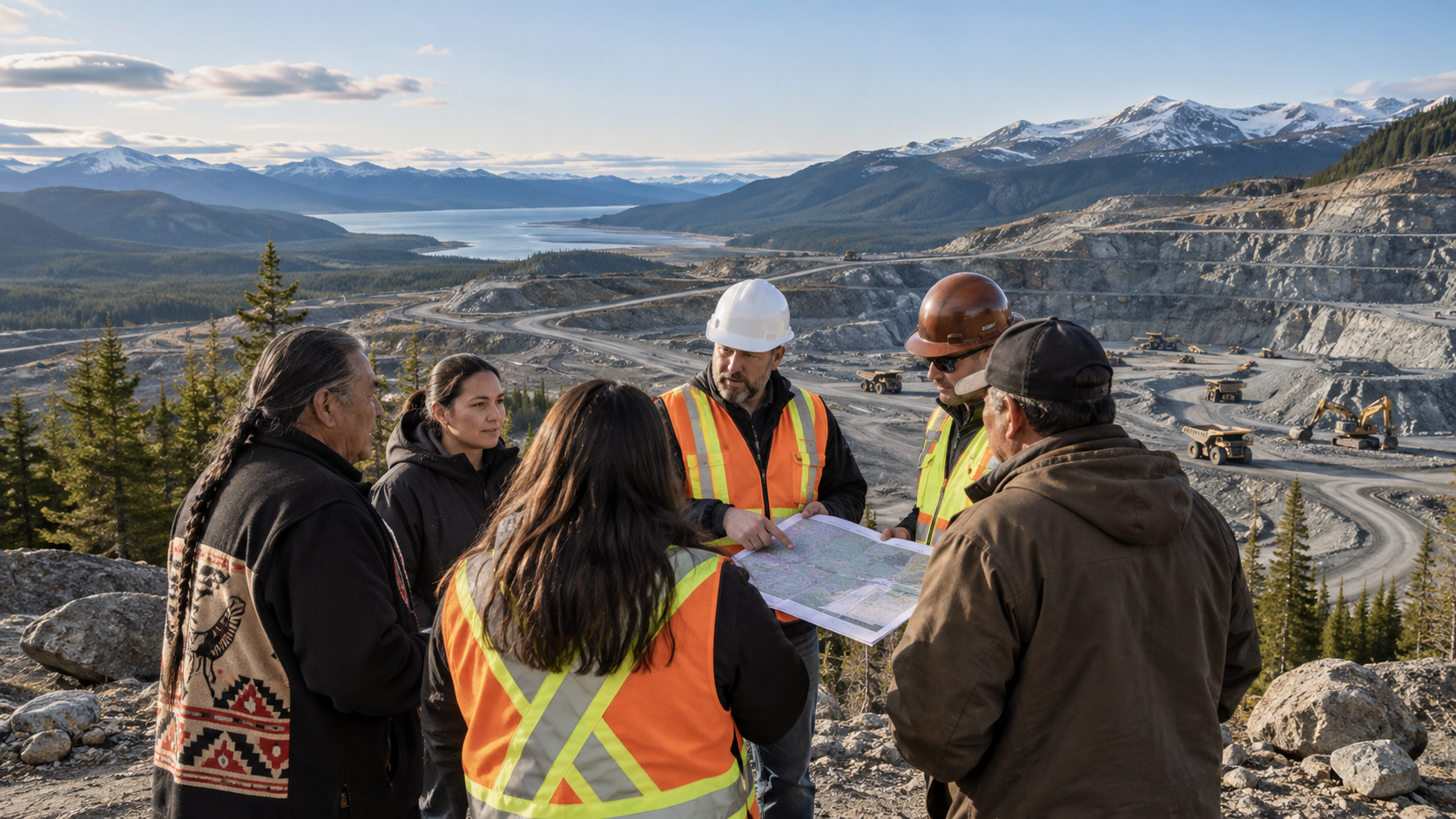
Think of a small miner negotiating with a landowner while nearby households use the same road. The landowner’s consent may address one issue, but not traffic, dust or continued access for those households.
A responsible plan identifies affected people and explains how their interests are considered. Depending on the circumstances, that could include landowners, occupiers, customary rights holders, local authorities and community representatives.
Representation deserves attention. Who selected a representative? What authority do they have? Have people who bear the disruption had a meaningful opportunity to participate?
Participation is not the same as unanimous support. Nor should a payment be treated as proof that every concern has disappeared. Applicable law may require particular consultation or consent processes, including protections for Indigenous peoples where relevant.
Useful arrangements explain how questions can be raised, complaints recorded and disagreements addressed. Clear communication helps prevent a practical concern—such as a blocked footpath—from becoming a larger dispute.
A mining opportunity is easier to understand when the plan shows who has rights, who participates and what the commitments cost.
3. How do local terms change mining economics?
For a young saver assessing a mining investment, production is only part of the picture. What must be paid or delivered before that production becomes profit?
Local terms may involve an upfront access payment, recurring rent, compensation, a production-linked share or agreed community works. These are examples of possible arrangements, not descriptions of specific agreements at Teqwah.
The calculation basis matters. A share of output is different from a share of revenue, and both differ from a share of profit. An obligation tied to production may still be payable when other operating costs leave little profit.
Consider a hypothetical site promising a share of production plus road maintenance. The production share is one cost. Grading the road, arranging equipment and maintaining access are additional commitments. Ignoring them would make the opportunity look stronger than it is.
Our risk disclosure describes a production-share calculation: gross site output for the cycle, less the landowner’s agreed cut, fuel, labour and operating costs, leaves net profit. That makes the landowner’s arrangement directly relevant to the financial picture.
Why this matters: a credible budget includes both cash payments and the work needed to meet commitments.
4. When can the site operate—and when must it stop?
An agreement can shape the calendar as much as the budget. Access might depend on notice, completion of compensation or restrictions around farming activities. The exact conditions vary by agreement and law.
Imagine equipment arriving before an agreed access route is available. The machines may be ready, yet transport, staffing or idle-equipment costs can accumulate while work waits.
Duration matters too. A short access term may not support a longer operating plan unless renewal is feasible. Renewal should not be treated as automatic when it is not.
We would also encourage readers to look beyond the start date. What happens during a dispute, a temporary suspension or closure? Who remains responsible for rehabilitation—making disturbed land safe and restoring it as required?
Why this matters: the operating model should reflect actual access conditions, not just hoped-for production days.
5. What should be documented before the numbers persuade you?
A handshake can begin a relationship. A clear record helps people understand what they have agreed to and how it will work.
A responsible plan should explain:
- Parties and authority: who signs, which rights they hold and whom they represent.
- Area and permitted use: boundaries, access routes, activities and restrictions.
- Economics and timing: payment formulas, deadlines, duration and renewal conditions.
- Responsibilities and remedies: monitoring, complaints, disputes, termination and closure duties.
Maps, payment records and documented changes can help make commitments traceable. Appropriate legal review is important; a written document alone does not establish that every right or approval is valid.
For a Teqwah investment, participants hold TGC as proportional participation in our unified pool rather than choosing an individual mine. We manage allocation across gold mining, physical gold trade, productive machinery and selected real estate. Local arrangements help explain why operating execution matters even when participation itself is straightforward.
Frequently asked questions
Is a land access agreement the same as a mining licence?
No. Access arrangements concern entry or use of land. Mining authorisations concern regulated mineral activity. The rights and approvals required depend on the jurisdiction; one document should not be assumed to provide everything.
Do community payments remove operating risk?
No. Payments do not eliminate disputes, permitting issues or production uncertainty. Clear terms and meaningful participation can help manage relationships, but they cannot ensure uninterrupted operations or positive financial results.
How should a participant use this information?
Ask whether the operating explanation connects rights, obligations, timing and costs. Avoid judging an opportunity only by its production potential. With TGC, recorded value can rise or fall, and the unit is not exchange-traded.
The opportunity is exciting precisely because value must be created through execution. Keep exploring how real operations connect to participation: Explore Teqwah →.
Investing involves risk, values can fall, and this article is education, not financial advice.
Teqwah view
At Teqwah, we bring participation closer to productive operations through TGC, while we manage allocation across our unified pool. Our risk disclosure includes the landowner’s agreed cut in the calculation from site output to net profit, so understanding local terms helps readers connect the operating story with the financial one. We invite you to explore that connection with both curiosity and a clear view of risk.
Sources
Investing involves risk. TGC value can fall. This is not investment advice.
Comments
No comments yet — be the first.