Kenya’s $16bn refinery plan raises the stakes for East African oil
Refinery projects in Kenya, Uganda and Tanzania promise less dependence on imported fuel, but could compete for the same crude and customers.
Key takeaways
- Kenya’s planned $16bn Lamu refinery would process up to 700,000 barrels a day, more than 11 times Uganda’s proposed capacity.
- Uganda’s 60,000-barrel-a-day Hoima project is still working towards a final investment decision.
- Tanzania’s proposed Tanga refinery remains under study, with capacity and financing yet to be established.
- The projects could reduce reliance on imported fuel but compete for crude supplies and regional customers.
- Pipelines, ports and storage links will be central to the projects’ economic viability.
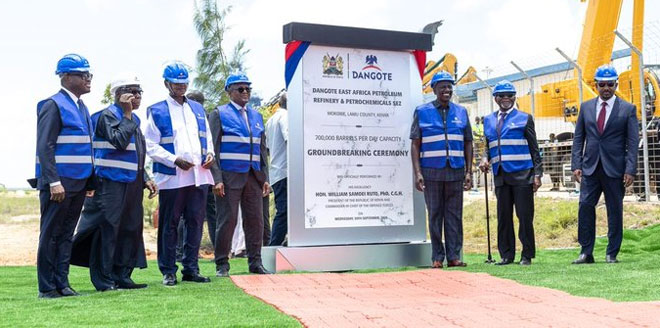
Kenya’s planned Lamu refinery would process more than 11 times as much crude as Uganda’s proposed plant—a scale that could reshape East Africa’s fuel market before its smaller projects get off the ground. According to The Independent Uganda (direct), construction of the $16bn Dangote project was formally launched on September 30. Its planned capacity is up to 700,000 barrels a day, with about 60,000 potential jobs. The challenge is securing enough oil and buyers alongside competing regional ambitions.
The project is backed by Nigerian industrialist Aliko Dangote, whose company already operates a 650,000-barrel-a-day refinery in Nigeria. He has said Lamu is intended to process African crude, including oil from Uganda, and sell fuel across the region. For Kenya, it would mark a return to refining after the Changamwe plant in Mombasa stopped processing crude in 2013 following financial and operational difficulties. That facility, commissioned in 1963, has since been used mainly for storage.
Three projects, different starting points
Uganda is pursuing its own 60,000-barrel-a-day refinery at Hoima, in the oil-producing Albertine region. The government has signed an agreement with UAE-based Alpha MBM Investments, but is still working towards a final investment decision—the commitment to proceed with the project. Planned products include petrol, diesel, cooking gas, kerosene and jet fuel, alongside inputs for petrochemicals, the chemicals made from petroleum. President Yoweri Museveni has maintained that Uganda needs a refinery to supply its domestic market and neighbouring areas.
Tanzania’s proposal is less advanced. Uganda, Tanzania and energy trader Vitol signed a memorandum of understanding in August for an energy hub at Tanga, including a refinery, storage, pipelines and other infrastructure. Tanzanian petroleum authorities say feasibility studies and work on land requirements have begun. The refinery’s eventual capacity and financing remain unsettled. It could process Ugandan crude and supplies from other regional producers, putting it within reach of some of the same resources sought by Lamu.
The promise depends on the connections
The governments’ broader aim is to reduce reliance on imported refined fuel. Long supply chains expose the region to global price swings, shipping disruptions and distant geopolitical events. Disruption around the Red Sea and Bab el-Mandeb has underscored those risks. Afreximbank argues that African refining could save foreign exchange, shorten supply routes and support more trade within the continent. Its president and chairman, George Elombi, links that shift to jobs and keeping more value from natural resources in Africa.
Refining more African crude on the continent would retain more value, create jobs and strengthen trade between African economies, according to Afreximbank president George Elombi.
Yet capacity alone does not guarantee a workable business. Uganda is preparing for commercial oil production, South Sudan already produces oil, and Kenya does not currently produce enough crude to supply a plant of Lamu’s proposed size. Governments describe the projects as potentially complementary, serving domestic needs, regional fuel buyers and petrochemical industries. Still, their overlapping ambitions could leave them competing for feedstock—the crude they process—and customers.
Transport links will therefore matter almost as much as the plants. Uganda’s crude is expected to move through the 1,443-kilometre East African Crude Oil Pipeline to Tanga. Lamu is being developed within the Lamu Port-South Sudan-Ethiopia Transport corridor. Pipelines, ports, storage terminals and roads will determine how producers reach refineries and how finished fuel reaches consumers. Those networks could also create rival routes through the regional market.
Afreximbank says it has invested about $15bn in the Dangote Group since 2015, including financing for its Nigerian refinery. It has also established a $3bn revolving facility—a financing pool that can be reused as funds are repaid—to support petroleum trade within Africa. The next tests are Uganda’s investment decision, Tanzania’s feasibility and financing work, and whether the planned infrastructure can secure enough crude and demand to make the region’s refining ambitions economically viable.
Sources
Investing involves risk. TGC value can fall. This is not investment advice.
Comments
No comments yet — be the first.