UAE asteroid probe puts private industry at the heart of a Dh44bn space push
The MBR Explorer has reached flight readiness in less than two years, Sheikh Hamdan says, with half the mission’s work allocated to UAE-based private companies.
Key takeaways
- Sheikh Hamdan says the UAE-built MBR Explorer reached flight readiness in less than two years.
- The UAE Space Agency has allocated 50% of the mission’s work to UAE-based private companies.
- Sheikh Hamdan values the UAE space sector at more than Dh44 billion and aims to double space-economy returns by 2031.
- A launch is scheduled for 2028, followed by a journey to study seven asteroids.
- Research includes the potential use of asteroid resources in future exploration, rather than an announced extraction project.
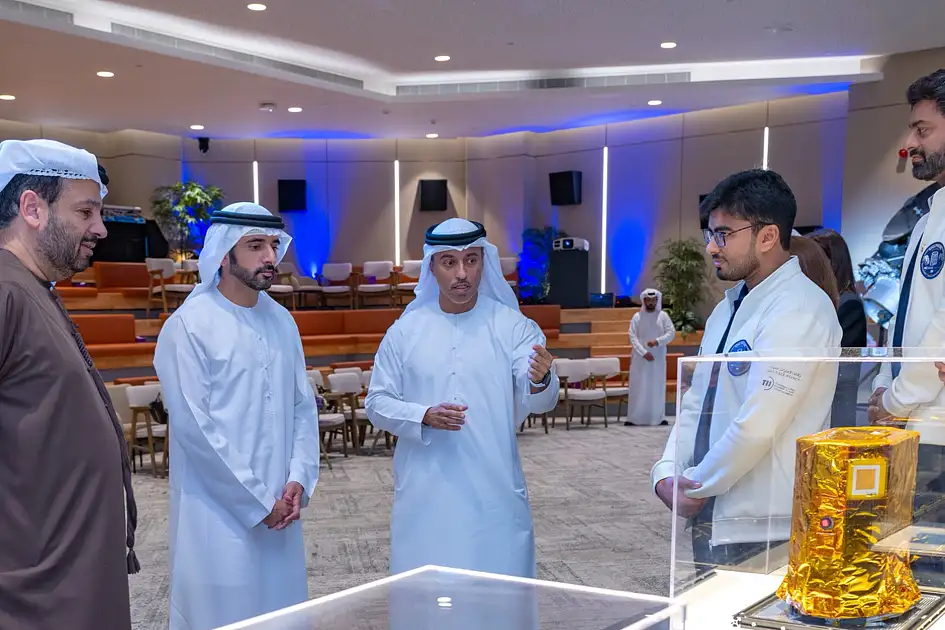
A spacecraft built to explore seven asteroids is also carrying a business ambition: to help expand the UAE’s space industry. Half the work on the Emirates Mission to the Asteroid Belt has been allocated to private companies based in the country, according to the UAE Space Agency. That gives domestic businesses a substantial role in a project whose probe has reached flight readiness in less than two years, Dubai Crown Prince Sheikh Hamdan bin Mohammed bin Rashid Al Maktoum said, according to Khaleej Times.
The UAE has unveiled the probe, called MBR Explorer, ahead of a launch scheduled for 2028. In a post on X, Sheikh Hamdan said it had been developed, assembled and tested in the UAE. More than 150 engineers and scientists are working together on the mission, which is intended to cover about 5 billion kilometres. He highlighted the growing contribution of Emirati scientists and engineers to the country’s space programme.
A space mission with an industrial role
The economic stakes extend beyond the spacecraft itself. Sheikh Hamdan put the value of the UAE’s space sector at more than Dh44 billion. He also set out an ambition to double the returns from the space economy by 2031 and place the country among the world’s 10 leading space economies. Those are stated goals, rather than outcomes already secured.
“By 2031, we aim to double the returns of the space economy and establish the UAE among the world’s top 10 space economies,” Sheikh Hamdan said.
The mission is designed to build private-sector capacity alongside scientific knowledge. The Space Agency expects it to open opportunities for startups, international partnerships and investment in the country’s space industry. Allocating half the project’s work to UAE-based private businesses gives those companies a direct place in that effort. The programme also aims to strengthen academic capabilities and the wider network of businesses and institutions developing advanced technology.
For Sheikh Hamdan, the people behind the hardware are central to that ambition. He praised Emirati expertise and reiterated the country’s commitment to investing in people, knowledge and technology. The mission therefore has two parallel purposes: gathering information about distant asteroids and developing skills and capabilities within the UAE.
A long route to seven asteroids
The journey itself will rely on gravity-assist manoeuvres: passes around planets that use their gravity to help a spacecraft travel onward. MBR Explorer is scheduled to use Venus, Earth and Mars before reaching the main asteroid belt beyond Mars. The wider 13-year programme includes six years of spacecraft development and a seven-year journey through the belt.
The probe is expected to make close passes by six asteroids before reaching a seventh, Justitia. There, it will release a lander to gather information from the surface. Scientists expect the mission to provide measurements of asteroid composition, geology, density and temperature, among other properties, helping them study how the solar system formed and evolved.
The Space Agency has also identified water-rich asteroids as a subject for research into resources that might support future space exploration. That remains an area of study, not an announced extraction project. The next scheduled milestone to watch is the 2028 launch, as the UAE pursues both the mission’s scientific objectives and its longer-term space-economy ambitions.
Sources
Investing involves risk. TGC value can fall. This is not investment advice.
Comments
No comments yet — be the first.