What Does 999.9 Mean on a Gold Bar? Purity Explained
999.9 means 99.99% gold by mass. Learn how fineness, assay testing and a reliable custody trail help you assess what a gold bar’s stamp really means.
Key takeaways
- 999.9 fineness means 999.9 parts gold per thousand by mass, equivalent to 99.99% purity.
- Fine gold content equals the bar’s total mass multiplied by its fineness divided by 1,000.
- A purity stamp needs support from reliable testing, identification and a credible chain of custody.
- High purity does not establish a fair purchase price or protect against investment losses.
You are standing at a bullion counter. Two gold bars catch the light. Both look convincing, but one carries a number you recognise without quite understanding: 999.9. Does that mean pure gold? Is the stamp enough to trust?
At Teqwah, we want you to look beyond the shine. Understanding that small number is a practical first step towards understanding physical gold—and the work that makes a gold transaction trustworthy.
A gold bar marked 999.9 indicates 999.9 parts gold per thousand by mass, or 99.99% gold, subject to a trustworthy assay and marking. Here is how to read that claim and decide what evidence should support it.
What does 999.9 mean on a gold bar?
The number describes fineness: how much of a metal object’s mass is gold, expressed in parts per thousand.
Imagine dividing the bar’s total mass into 1,000 equal portions. A fineness of 999.9 means 999.9 of those portions are gold. The remaining 0.1 portion consists of other material, often trace amounts of other metals.
To convert fineness into a percentage, divide by ten:
999.9 ÷ 10 = 99.99% gold.
For a bar weighing exactly 100 grams, that stated purity corresponds to 99.99 grams of fine gold and 0.01 gram of other material. That is a calculation based on the stated mass and fineness, not independent proof of either.
Why this matters: the stamp describes a proportion. It does not tell you the bar’s weight, selling price or authenticity on its own.
A 999.9 stamp tells you the claimed purity. Reliable testing and custody give that claim substance.
Is 999.9 gold the same as 24-karat gold?
A young saver might hear a shopkeeper say “24-karat” while the bar itself says “999.9.” These are two ways of describing gold purity, but they use different scales.
Karats express gold content in 24 parts. Fineness expresses it in 1,000 parts. Gold marked 999.9 is commonly described as 24-karat gold, although that broad description does not mean absolute, impurity-free gold.
Compare three fineness marks:
- 999: 99.9% gold by mass.
- 999.9: 99.99% gold by mass, often called “four nines.”
- 995: 99.5% gold by mass.
The extra decimal is meaningful, but it should not distract you from the bigger decision. A higher purity claim is useful only when it is credible.
Nor does higher fineness automatically mean a better purchase. Price, transaction costs, authenticity and the terms for selling later all deserve attention. We encourage readers to understand the whole transaction, not just choose the largest number.
How much gold are you actually buying?
Suppose you are comparing two bars with different weights. Looking only at purity can make the comparison confusing. The useful quantity is fine gold content: the mass of gold contained in the bar.
The calculation is straightforward:
Fine gold content = total bar mass × fineness ÷ 1,000.
A 10-gram bar at 999.9 fineness therefore contains a stated 9.999 grams of fine gold. A 100-gram bar at the same fineness contains a stated 99.99 grams.
Keep the units consistent, and distinguish the bar’s metal weight from any packaging weight.
The amount you pay may also include refining, fabrication, distribution and the seller’s premium. When you sell, the buyer’s offer may reflect testing costs and their own margin.
Why this matters: purity is not price. Two genuine bars with the same fine gold content can carry different purchase prices. Ask what you are paying beyond the metal, and what deductions might apply when you sell.
What makes a 999.9 stamp trustworthy?
Anyone assessing a bar faces the same problem: its outside does not reveal everything about its inside. A convincing appearance, neat lettering or attractive certificate cannot independently establish the gold content.
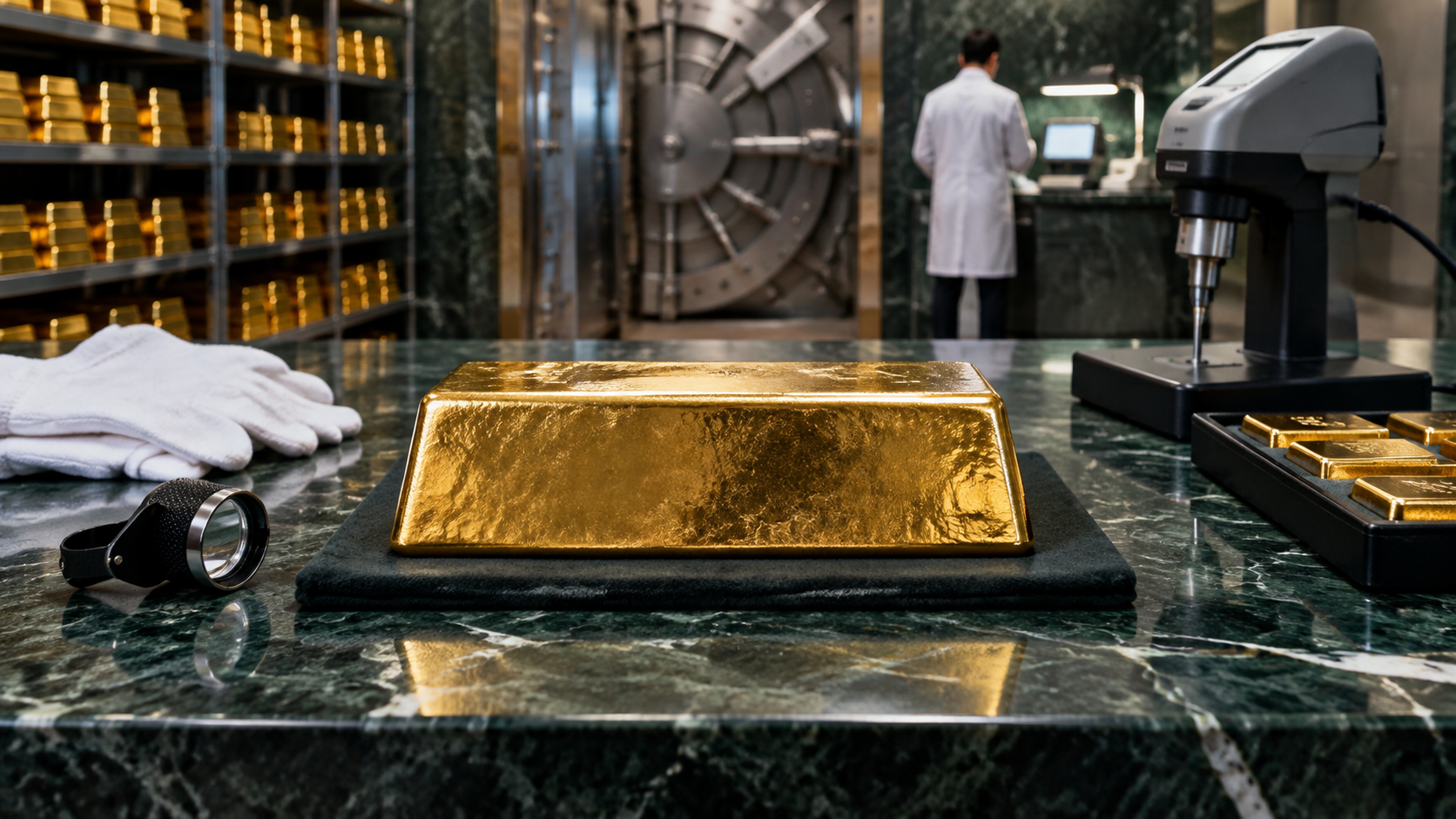
An assay is a test used to determine precious-metal content. Different methods answer different questions. X-ray fluorescence, often called XRF, can assess surface composition, but a surface reading alone may not establish the composition throughout a bar. Other checks or sampling may be needed depending on the circumstances.
We would not treat a single test as a universal answer. The appropriate approach depends on the bar, its source and the risk being assessed.
Then comes chain of custody: the documented trail of who held and transferred the metal. Good records help connect a test result to the actual bar being offered, rather than to an unrelated sample.
Before buying, ask:
- Who produced the bar, and who is selling it?
- What testing supports the stated fineness, and who performed it?
- Do identifying details, where present, match the documentation?
- Is there a credible custody trail and a clear process for resolving discrepancies?
Packaging and serial numbers can support these checks. Neither replaces testing or makes a bar automatically genuine.
Why this matters beyond the bullion counter
For a small miner, producing gold is only part of the journey. Material must also be assessed and handled through a credible commercial process. For a saver, understanding that journey helps separate physical gold’s qualities from the claims made around it.
At Teqwah, gold mining and physical gold trade are core activities. We source, consolidate, assess and move physical gold through documented channels. That makes this distinction important: the metal, its assessment and its records each play a different role.
For people who see potential in gold but cannot run a mine themselves, our TGC participation connects them to a unified pool across gold mining, physical gold trade, productive machinery and selected real estate. TGC is a divisible participation unit, not a gold-purity mark or an exchange-traded product. Its recorded value can rise or fall.
That is the opportunity we are working to build: participation in productive operations, where value must be created through execution—not inferred from a stamp.
Frequently asked questions
Does 999.9 mean 100% pure gold?
No. It means 99.99% gold by mass. It is very high purity, but it is not a claim of absolute purity.
Can a fake gold bar carry a 999.9 stamp?
Yes. Markings can be copied. Trust depends on reliable testing, identification and custody records—not the number alone.
Does 999.9 purity protect me from investment losses?
No. Authenticity and purity do not prevent gold prices from falling or transaction costs from affecting your outcome.
We invite you to keep exploring how physical gold and productive operations fit into our approach. Explore Teqwah →
Investing involves risk, values can fall, and this article is education—not financial advice.
Teqwah view
At Teqwah, we connect gold mining and physical gold trade with productive operations, and we assess and move physical gold through documented channels. We want you to understand both the metal and the work behind it, because informed participation starts with knowing what a number does—and does not—tell you.
Sources
Investing involves risk. TGC value can fall. This is not investment advice.
Comments
No comments yet — be the first.