What Is Alluvial Gold? From River Sediment to Real Value
Learn how alluvial gold forms, how it is recovered, and why testing, land access and operating costs matter before mining equipment arrives.
Key takeaways
- Alluvial gold is transported and deposited by water, often among river or stream sediments.
- Recovery commonly uses gravity separation to concentrate dense gold particles, but not all gold is captured.
- Representative testing, lawful land access and an operating plan should come before equipment deployment.
- Gold content alone does not establish profitability; recovery, costs, downtime and capital requirements also matter.
Could a handful of river gravel hold gold—and if it does, would recovering it make financial sense? Those are two different questions. The first is about geology. The second is about building a workable operation.
At Teqwah, we see the appeal of connecting capital with productive gold operations. But understanding the work comes first. Alluvial gold offers a useful starting point: its recovery can look straightforward, while the decisions behind it require careful judgement.
What is alluvial gold, and where does it collect?
Alluvial gold is gold carried and deposited by flowing water, often within river or stream sediments. It begins with gold-bearing material being exposed and broken down by weathering and erosion. Water then transports the released particles alongside sand, silt and gravel.
Gold is much denser than most of that material. As flowing water loses energy or encounters natural traps, gold can settle and accumulate. Bedrock cracks, gravel layers and parts of old river channels may hold concentrations worth investigating.
Think of shaking a container filled with different-sized objects: they do not remain evenly mixed. Water also sorts material, although river behaviour is more complicated than a simple shake.
Alluvial deposits are one type of placer deposit—a concentration of valuable minerals formed through natural physical sorting. Not every placer deposit is river-made; some develop along beaches.
Why this matters: a river with traces of gold is not automatically a mine. The concentration, location and recoverability of that gold make the difference.
How is alluvial gold recovered?
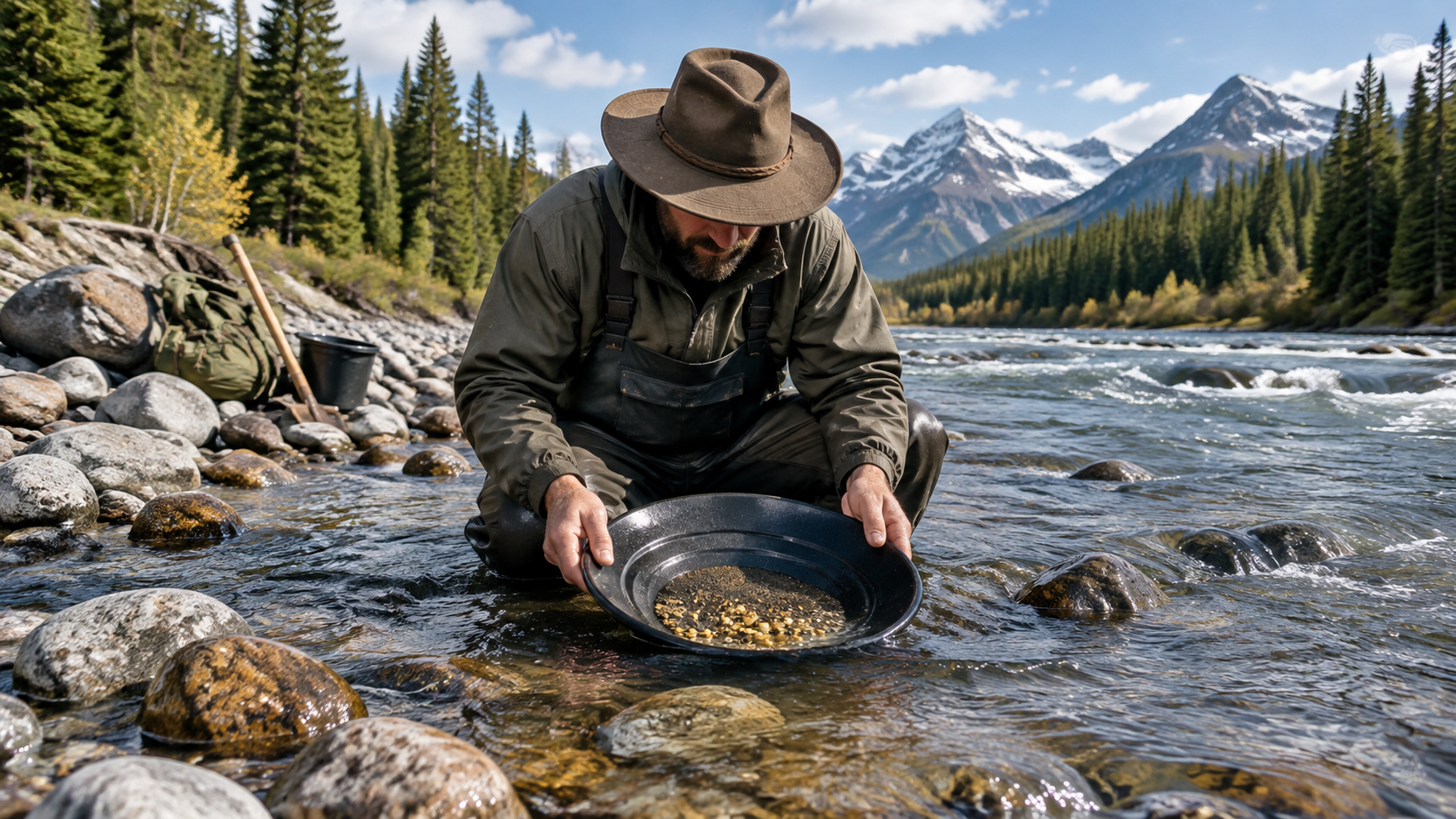
Imagine a small miner washing gravel in a pan. Lighter material moves away, while heavier particles remain. Commercial alluvial gold recovery often builds on the same principle: gravity separation, which uses differences in density to concentrate gold.
Depending on the material, a processing setup may include screens to sort particle sizes, washing equipment to break up clay, and sluices or other gravity concentrators to capture dense particles. Excavators and pumps may support excavation and water movement.
Unlike gold locked inside hard rock, liberated alluvial gold may not require crushing the host rock before separation. That can simplify part of the process. It does not make every deposit cheap or easy to work.
Fine gold can escape with waste material. Sticky clay can slow processing. Poorly controlled water flow can reduce recovery. A machine's advertised capacity says little about how well it will handle a particular deposit.
Gold in the ground is potential; testing, access and disciplined operations determine whether that potential becomes value.
What needs to happen before equipment arrives?
Picture a shopkeeper renting a larger shop before checking whether enough customers live nearby. Buying mining machinery before understanding a deposit creates a similar problem: spending begins before the business case is clear.
A sensible assessment asks:
- Is the sample representative? Testing should cover relevant areas and depths, not just the most promising patch.
- How much gold can actually be recovered? Grade measures concentration; recovery describes the share the process captures.
- Can the land legally be worked? Access agreements, mineral rights and required approvals need checking under local rules.
- Can the site operate responsibly? Water use, sediment control, worker safety and land rehabilitation need planning.
- Can the operation be supported? Roads, fuel, spare parts, people and seasonal conditions affect practical access.
Alluvial gold can be unevenly distributed. A rich sample may sit beside much poorer ground, so one attractive pan cannot establish a reliable production forecast. Additional sampling and appropriate processing trials help test assumptions.
Why this matters: the right equipment follows the evidence. It should not replace it.
What turns recovered gold into an economic opportunity?
For a young saver following gold, the metal's price may be the most visible number. For an operator, it is only one part of the calculation.
A simplified operating relationship is:
Material processed × gold grade × recovery rate = recovered gold.
The units must match. If material is measured by volume, grade must be expressed on a compatible volume basis. Even then, this is a planning relationship, not proof of future production.
The next question is what remains after costs. Fuel, labour, maintenance, site access arrangements, water management and transport all affect the result. Equipment purchase or rental and working capital also need funding.
Suppose two sites contain similar gold concentrations. One has accessible gravel and a manageable water supply. The other has thick overburden—the material covering the target layer—and difficult access. Similar geology can produce very different economics.
Downtime matters too. A processing plant cannot earn from material it never receives. Seasonal flooding, breakdowns or missing spare parts can interrupt an otherwise promising plan.
This is the opportunity we find exciting: value must be created through execution, not simply inferred from the presence of gold.
How does this connect with participation at Teqwah?
For people who see potential in gold but cannot run a mine themselves, understanding the operating chain helps make participation more tangible. Capital supports work; work produces results; those results can be positive or negative.
At Teqwah Capital, we deploy capital across gold mining, physical gold trade and productive machinery, with selected real estate also within our mandate. Participants hold TGC, a divisible participation unit representing a proportional share of our unified pool. They do not choose individual mines or projects.
This article explains a deposit type, not a claim that a particular alluvial site belongs to our operations. The distinction matters: understanding alluvial gold does not establish the quality or economics of any specific investment.
Our TGC value is based on recorded pool value divided by circulating TGC. It is not an exchange-traded market price, and it can fall. We invite you to understand both the productive opportunity and the terms of participation before deciding.
Frequently asked questions
Is alluvial gold real gold?
Yes. “Alluvial” describes how gold was transported and deposited, not a separate metal. Recovered material may contain other minerals and needs assessment to establish its gold content and purity.
Is alluvial mining easier than hard-rock mining?
It can avoid some rock-breaking and crushing where gold is already liberated. However, uneven grades, fine particles, clay, water conditions and access can still make recovery difficult or uneconomic.
Does finding alluvial gold mean a project will be profitable?
No. Profitability depends on representative testing, recoverable gold, permissions, costs and reliable execution. Visible gold alone cannot answer those questions.
Curious about how we connect participation with productive operations? Explore Teqwah and TGC →
Investing involves risk, values can fall, and this article is education, not financial advice.
Teqwah view
At Teqwah, we connect participation with gold mining, physical gold trade and productive assets through one unified pool. We believe understanding the work behind gold helps you approach that opportunity with clearer expectations: TGC records proportional participation, while results remain variable and value can fall.
Sources
Investing involves risk. TGC value can fall. This is not investment advice.
Comments
No comments yet — be the first.