US companies explore Syria’s rebuilding push as financing becomes the test
A delegation of more than 50 American businesses signals growing interest in Syria, but banking restrictions, reputational risks and a budget gap complicate the opening.
Key takeaways
- More than 50 US businesses joined an exploratory delegation to Damascus, including Baker Hughes, Caterpillar and Visa.
- The World Bank estimates Syria’s reconstruction needs at $216 billion.
- Banking reforms include new international payment access and a $100 million World Bank grant.
- Syria reported a roughly $1 billion fiscal deficit for the first half of 2026, while compliance and reputational risks remain.
- Gulf partnerships could offer US companies a route into projects as the chamber pursues further engagement.
More than 50 American businesses joined a recent delegation to Damascus, exploring opportunities in a country the World Bank estimates will need $216 billion to rebuild. Baker Hughes, Caterpillar and Visa were among the participants. For Syria’s transitional government, the challenge is to turn that early interest into lasting investment while rebuilding financial links and managing a shortage of public money, according to The National — Business.
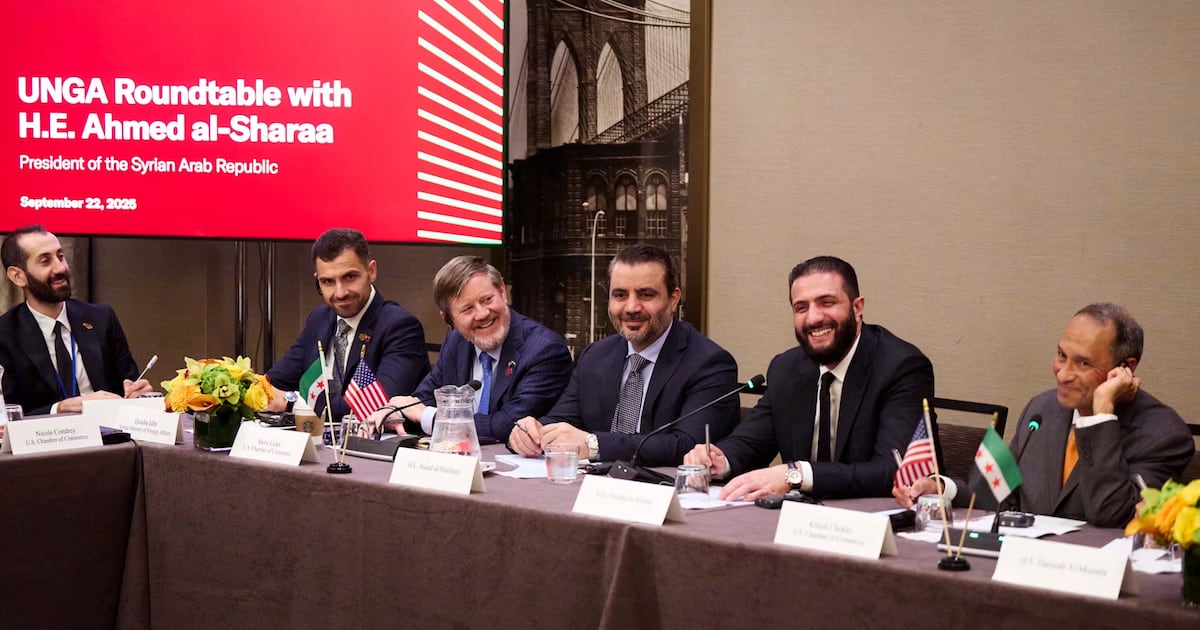
Steve Lutes, vice president of Middle East Affairs at the US Chamber of Commerce, led the visit, which brought together 80 delegates. He described it as an exploratory mission: a chance for companies to find potential investments and rebuild trust with Syrian officials after the 13-year civil war. The chamber also hosted President Ahmad Al Shara and Foreign Minister Asaad Al Shibani at a round-table on the sidelines of the UN General Assembly. Lutes told The National that American companies across several sectors were interested in becoming long-term partners.
“The biggest challenge at the end of the day are the budgetary constraints and how are they going to finance and pay for it all,” Steve Lutes told The National.
Banking is the gateway
Since Bashar Al Assad’s regime fell in 2024, Syria’s government has pursued investors from Silicon Valley to Riyadh. Some Gulf commitments have begun moving towards implementation, including DP World’s $800 million commitment to Tartus Port. The American delegation followed the US removal of Syria’s state sponsor of terrorism designation, which the report described as a major obstacle to restoring the country’s access to the international financial system.
The chamber is placing particular emphasis on banking, which Lutes sees as essential to investment elsewhere in the economy. Al Shara carried out Syria’s first international Visa transaction in August, while QNB and Mastercard issued the country’s first internationally accepted payment card. The World Bank has approved a $100 million grant to help build a digitally enabled financial sector. Central Bank Governor Mohammed Raslan told official news agency Sana that foreign investment in establishing new banks was expected to exceed $1 billion in the coming period.
Financial access also requires stronger safeguards. At a US Treasury round-table in New York, discussions included standards to prevent money laundering and the financing of terrorism, Finance Minister Yisr Barnieh said in a LinkedIn post. Treasury official Jonathan Burke stressed that connections to the global financial system were important both for tackling illicit finance and for Syria’s reintegration, according to a readout.
Interest meets financial constraints
The government’s own accounts show the pressure. Public spending reached about $3.7 billion in the first half of 2026, against revenue of $2.7 billion, leaving a roughly $1 billion deficit — the gap between spending and income. Damascus said it was reviewing investment projects as part of measures to control expenditure. Barnieh said salaries, wages and essential services, including health, education, water and energy, would be protected.
Risks remain for foreign companies despite the US delisting. Syria is still on the Financial Action Task Force’s grey list, which flags weaknesses in safeguards against illicit finance. Potential counterparties may also have past links to sanctioned actors. Even so, ConocoPhillips, Chevron, Baker Hughes, Hunt Energy and Ardent LNG have signed memorandums of understanding or other agreements with Syria. Qatar’s UCC Holding has joined Chevron and Syria’s state petroleum company in an agreement to develop the country’s first offshore oil and gasfield.
Lutes expects more American companies could work with Emirati, Saudi or Qatari partners that already have relationships in Syria, potentially reducing risks and building confidence. He hopes the Damascus delegation becomes an annual event, while the chamber continues discussions on policy and regulatory issues. The next test is whether exploratory visits and agreements become funded projects as Syria repairs its banking links and confronts its budget limits.
Sources
Investing involves risk. TGC value can fall. This is not investment advice.
Comments
No comments yet — be the first.