Cheap power puts UAE and Saudi Arabia at the centre of a 3GW data push
S&P expects the two countries to hold more than 80% of regional data centre capacity by 2030, with major AI projects potentially lifting growth further.
Key takeaways
- S&P expects the UAE and Saudi Arabia to add around 2–3 GW of IT power and hold more than 80% of regional data centre capacity by 2030.
- Large projects, including Stargate UAE and Humain’s Saudi developments, could lift capacity beyond the forecast.
- The UAE is accelerating construction, while Saudi additions are expected later in the decade.
- Estimated construction costs average $11 million per megawatt in the UAE and $13 million in Saudi Arabia over 2026–2030.
- Low electricity prices and local data storage requirements support the region’s expansion.
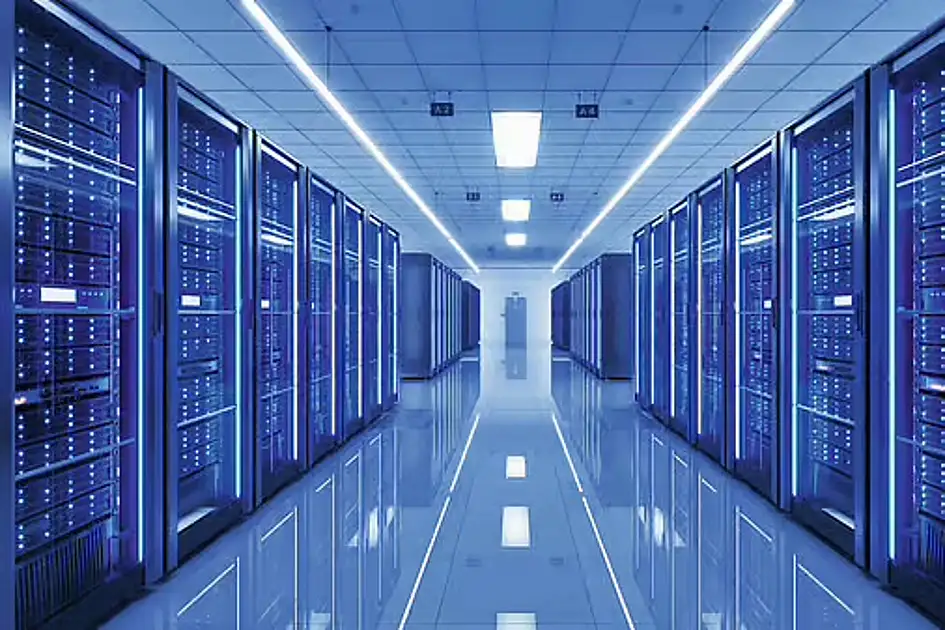
Electricity priced well below global averages is giving the UAE and Saudi Arabia an edge in the race to build data centres. Together, they are expected to add around 2–3 gigawatts of IT power—the electricity capacity supporting computing equipment—and account for more than 80% of the region’s data centre capacity by 2030, according to an S&P report covered by Khaleej Times.
That expansion would still represent less than 2% of global IT power, S&P said. The contrast shows the scale of the wider market: the US and Canada are expected to supply 70% of new data centre capacity over the next four years. The Gulf’s two leading markets are growing quickly, but North America remains the main source of new capacity.
Big projects could lift the forecast
The UAE’s project pipeline includes Stargate UAE, a planned 5-GW AI infrastructure campus in Abu Dhabi that could push capacity beyond the forecast. Based within the UAE-US AI Campus, the project brings together G42, OpenAI, Nvidia, Oracle, Cisco and SoftBank. Its initial 1 GW is expected to be completed over the next three years, making the delivery schedule a key marker for the country’s expansion.
Saudi Arabia has a large pipeline of its own. Projects developed by Humain, a company backed by the Public Investment Fund, could bring data centre power to as much as 1.9 GW by 2030. That figure could rise to between 6.0 GW and 6.6 GW in 2034, according to the report. These projects could also lift the regional outlook beyond the expected additions.
The two countries are not moving at the same pace. S&P expects Saudi capacity additions to arrive later in the decade, while the UAE is accelerating its build-out. Capital expenditure—the money spent on buildings, equipment and other long-term assets—is expected to follow those different delivery schedules, both in timing and scale.
S&P identifies affordable, accessible energy as a crucial advantage for the region’s data centre prospects.
Construction costs and local control
Building the facilities will require substantial spending. Estimates from 451 Research put average construction costs over 2026–2030 at about $11 million per megawatt in the UAE and $13 million in Saudi Arabia. A megawatt is one-thousandth of a gigawatt. The comparable estimates are $12 million per megawatt in Europe and $13 million in North America. Alongside its low electricity prices, the UAE is investing heavily in nuclear energy to supply data centres.
Rules governing where information is stored are another source of demand. The report points to personal data protection laws in both countries, alongside cloud computing and cybersecurity frameworks that require local storage. These rules, and sovereign cloud policies designed to retain control over data, support demand for domestic facilities and local partners. Investment priorities also include data literacy, AI security and AI-enabled tools.
Joint ventures pairing US or Chinese large-scale cloud providers with local partners that retain operational control will be important to meeting digital sovereignty goals, S&P said. The next milestones to watch are the UAE’s initial Stargate delivery and the timing of Saudi Arabia’s later-decade additions. Those schedules will shape when the expected construction spending turns into operating capacity.
Sources
Investing involves risk. TGC value can fall. This is not investment advice.
Comments
No comments yet — be the first.